
If you live or run a business in Peshawar or surrounding areas, you’ve probably received your electricity bill from PESCO (Peshawar Electric Supply Company) and wondered why the cost per unit sometimes feels higher than expected. The reason often comes down to peak hours — those specific time slots when electricity demand is at its highest.
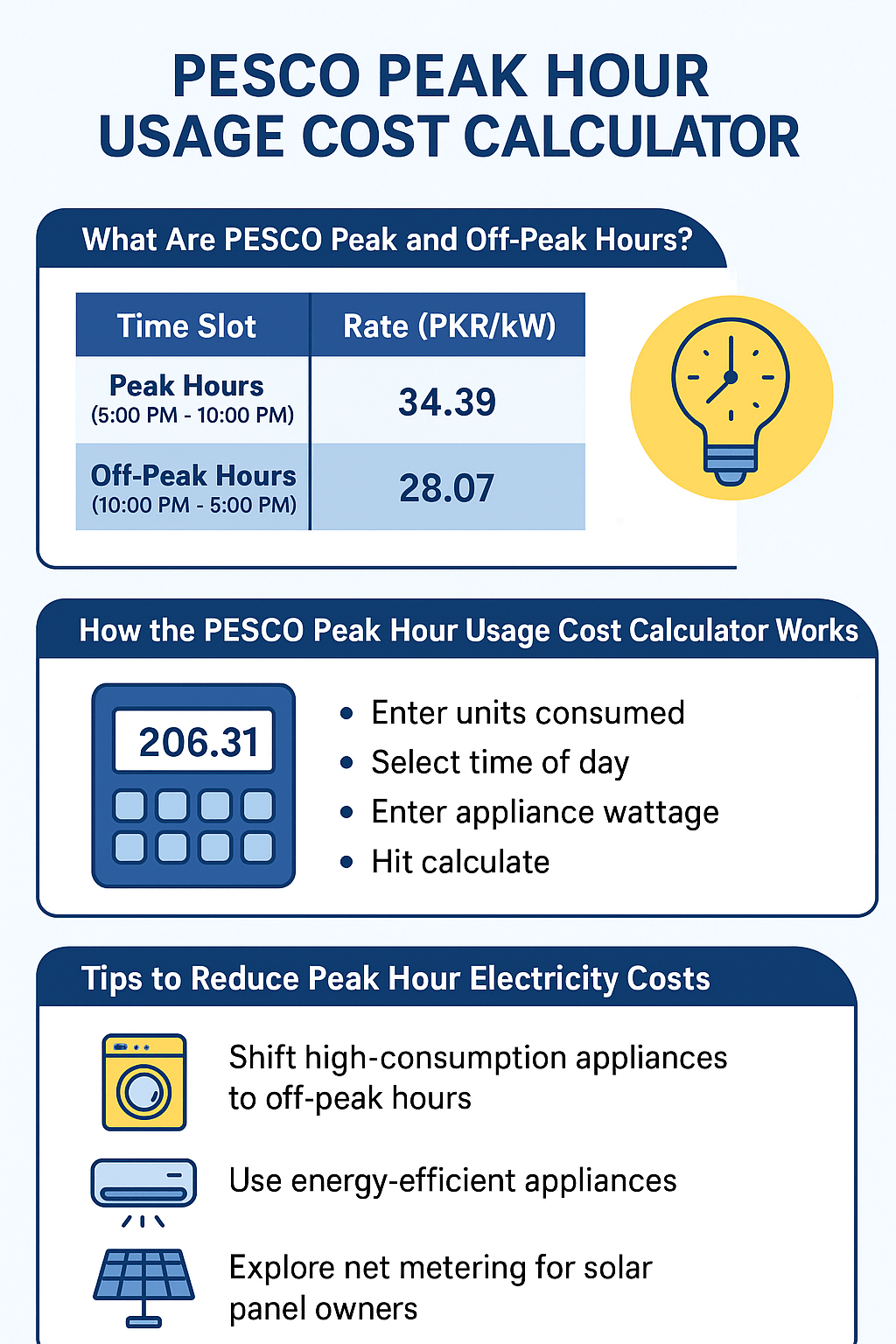
Under the Time-of-Use (TOU) tariff system, PESCO divides the day into peak hours and off-peak hours. During peak hours, the per unit rate (PKR/kWh) is noticeably higher, reflecting the extra demand on the grid. Off-peak hours, on the other hand, come with reduced electricity tariff slabs, offering a more budget-friendly rate.
This is where the PESCO Peak-Hour Usage Cost Calculator becomes an invaluable tool. By simply entering your appliances, their wattage, and the number of hours you use them during peak and off-peak slots, you can instantly see how much each is costing you. For households, it’s a way to optimize energy use and reduce unnecessary expenses. For businesses, it’s a chance to strategically plan high-energy tasks during cheaper hours — ultimately saving thousands in monthly electricity costs.
With the right information and tools, you’re not just paying your bill — you’re controlling it.
PESCO Peak Hour Cost Calculator
✅ PESCO online bill check with a single click for instant access
Using the PESCO Peak Hour Usage Cost Calculator
We’ve taken the guesswork out of managing your electricity bill with our custom-built PESCO Peak Hour Usage Cost Calculator—a simple yet powerful tool available right here on our website. Instead of wondering how much your evening energy use is costing you, you can now see the numbers instantly and make informed choices.
Step-by-Step Guide
1. Enter Units Consumed
Add the total number of units (kWh) you expect to use. This could be the consumption of a single appliance—like your AC or water heater—or the total usage of your home or business during a specific time frame.
2. Select Time of Day
Choose whether you’re calculating for peak hours or off-peak hours. The calculator follows PESCO’s official Time-of-Use (TOU) schedule, ensuring the correct rate is applied automatically.
✅ Hassle-Free PESCO Bill Check: Get old bills in seconds
3. Enter Appliance Wattage
For more precise results, you can enter the exact wattage of your appliance. For example, a 1,800-watt geyser or a 120-watt ceiling fan. This helps you calculate cost down to the last rupee.
4. Hit Calculate
In seconds, the tool applies NEPRA-approved PESCO tariff rates for your selected time slot, showing you an accurate cost breakdown.
How the Tool Works Behind the Scenes
Our calculator is programmed with the latest PESCO electricity tariff slabs and TOU billing method. It multiplies your entered units or wattage by the applicable per unit rate—higher during peak hours and lower during off-peak hours—and then totals it for both monthly and annual estimates.
✅ Access PESCO industrial bills 24/7 using online bill check
Understanding Your Results
When you click calculate, you’ll instantly see:
-
Cost for the selected time slot (peak or off-peak)
-
Monthly total if you keep the same usage pattern
-
Annual total to show long-term impact on your budget
-
Side-by-side comparison of peak vs. off-peak costs if you test both options
Why It’s Useful
By clearly showing the price difference between peak and off-peak hours, this tool gives you the power to shift energy usage and reduce costs. Even small changes—like running your washing machine at night—can lead to hundreds or thousands of rupees saved over the year.
So, go ahead—try different scenarios in our PESCO Peak Hour Usage Cost Calculator and see how much you can save. With real data at your fingertips, lowering your electricity bill becomes a smart, strategic decision.
✅ PESCO Load Finder: Determine required capacity
✅ PESCO E-Bill Subscription: Hassle-free notifications
What Are PESCO Peak and Off-Peak Hours?
Imagine electricity rates that shift with time—just like airline fares change during busy seasons. That’s exactly what the Time-of-Use (TOU) tariff from PESCO (Peshawar Electric Supply Company) does: it helps manage electricity demand and rewards savvy energy users by charging more during busy hours and less when the grid is calmer.
Official Time Slots for Peak vs. Off-Peak
-
Summer (April to October): Peak hours run from 6:30 PM to 10:30 PM—a four-hour window when everyone’s at home, lights and air-conditioning buzzing.
-
Winter (November to March): The grid sees its highest demand between 6:00 PM and 10:00 PM.
✅ Forecast your next PESCO bill using our reliable calculator
Current Per-Unit Rates (PKR/kWh)
Here’s a breakdown of Peak-hour rate vs. Off-peak rate, tailored across different user categories:
| Consumer Category | Peak-hour Rate (PKR/kWh) | Off-peak Rate (PKR/kWh) |
|---|---|---|
| Residential (5 kW & above) | ~34.39 | ~28.07 |
| Commercial (≥5 kW) | ~33.85 | ~27.88 |
| Industrial (≤25 kW) | ~30.39 | ~24.83 |
| Industrial (25–500 kW) | ~30.33 | ~24.62 |
These numbers reflect common electricity tariff slabs for the residential, commercial, and industrial categories under PESCO’s TOU structure.
Why It Matters
Knowing the Peak-hour rate (PKR/kWh) and Off-peak rate (PKR/kWh) empowers you to make smart energy decisions:
-
Residential users can shift laundry, charging, or heating to off-peak hours—saving on electricity costs.
-
Businesses and industries can plan high-energy tasks during off-peak windows to reduce operating expenses.
By blending clear facts with a conversational touch, this section helps readers understand not just when the price changes, but why it matters—and how to use that knowledge to their advantage.
Example: Calculating Your Peak vs Off-Peak Bill
Let’s put the PESCO Peak Hour Usage Cost Calculator to work with a couple of real-life examples. These will help you see how shifting your electricity usage can impact your bill—sometimes more than you’d expect.
Example 1 – Single Appliance
Imagine you run a 1,500-watt electric heater for 3 hours a day.
-
Daily usage in kWh = (1,500 watts ÷ 1,000) × 3 = 4.5 kWh
-
Peak-hour cost = 4.5 × 34.39 PKR = 154.76 PKR per day
-
Off-peak cost = 4.5 × 28.07 PKR = 126.31 PKR per day
Monthly difference: Over 30 days, using this heater only in off-peak hours would save you 854 PKR.
Example 2 – Multiple Appliances
Let’s say your household runs the following during peak hours:
| Appliance | Wattage | Hours/Day | Units (kWh) | Peak-Hour Cost | Off-Peak Cost |
|---|---|---|---|---|---|
| AC (Inverter) | 1,200 W | 5 | 6.0 | 206.34 PKR | 168.42 PKR |
| Washing Machine | 750 W | 1 | 0.75 | 25.79 PKR | 21.05 PKR |
| LED Lights (10 pcs) | 100 W | 6 | 0.6 | 20.63 PKR | 16.84 PKR |
Total Daily Cost:
-
Peak Hours: 252.76 PKR
-
Off-Peak Hours: 206.31 PKR
Monthly Savings: By moving all of these to off-peak hours, you’d save around 1,392 PKR per month—over 16,000 PKR a year.
✅ Secure PESCO Online Payment: Protect your money and data
At a Glance – Cost Comparison Table
| Usage Pattern | Daily Cost (Peak) | Daily Cost (Off-Peak) | Monthly Savings |
|---|---|---|---|
| Single Heater (1,500W) | 154.76 PKR | 126.31 PKR | 854 PKR |
| Mixed Appliances (Example 2) | 252.76 PKR | 206.31 PKR | 1,392 PKR |
✅ PESCO Load Calculator: Check required energy capacity
Why Peak Hour Costs More: The Tariff Structure
Ever wondered why your electricity bill spikes when you use power during certain hours? It all comes down to how the grid works and the way PESCO’s tariff structure is designed to balance demand and supply.
The Real Reason for Higher Peak Rates
During peak hours—those busy evening slots—everyone is at home, businesses are still running, and appliances are working overtime. This causes a surge in grid demand. To keep the system stable and prevent overloads, PESCO (under NEPRA’s guidelines) applies higher per-unit rates during peak hours.
This isn’t just about charging more—it’s about load management. By making peak electricity slightly more expensive, consumers are encouraged to shift usage to off-peak times, easing stress on the grid and reducing the chance of outages.
Peak vs Off-Peak Pricing
-
Peak-hour rate: Higher cost per kWh due to increased grid demand and operational strain.
-
Off-peak rate: Lower cost per kWh because fewer people are using electricity, making it cheaper to generate and distribute.
By shifting heavy appliance use—like running your washing machine, geyser, or air conditioner—to off-peak slots, you can directly lower your monthly bill.
✅ Bill Portal Directory: Pay Electricity, Gas & Water
Load Shedding vs Load Management
-
Load Shedding is the old-school method—cutting off power in certain areas to prevent a complete blackout.
-
Load Management is smarter—using pricing strategies (like the Time-of-Use tariff) to influence when people use electricity, reducing the need for blackouts altogether.
PESCO’s peak hour charges are part of this load management strategy—keeping the grid healthy without flipping the off-switch on entire neighborhoods.
Fixed Charges You Should Know About
Beyond per-unit pricing, there are also fixed charges per kW-month based on your sanctioned load or connected load:
-
Residential (above 5 kW): A fixed monthly fee per kW in addition to unit charges.
-
Commercial & Industrial: Higher fixed charges because of greater demand capacity.
These fixed charges stay the same no matter when you use electricity, but your usage timing still determines how much your bill fluctuates.
Tips to Reduce Peak Hour Electricity Costs
Lowering your electricity bill doesn’t have to mean giving up comfort or convenience. With a few smart adjustments, you can optimize your energy usage during off-peak hours and watch your savings grow—without any hassle. Here’s how:
Shift High-Consumption Appliances to Off-Peak Hours
One of the easiest ways to cut costs is to run power-hungry devices—like your washing machine, dishwasher, or water heater—during off-peak hours. This simple switch takes advantage of PESCO’s lower off-peak electricity rates, reducing what you pay per unit. Even shifting just a few hours can add up to significant savings over time.
Use Energy-Efficient Appliances
Investing in energy-efficient appliances is a win-win: lower electricity bills and a smaller carbon footprint. For example:
-
Inverter ACs use less power by adjusting compressor speed, especially during fluctuating demand.
-
LED lighting consumes up to 80% less electricity than traditional bulbs while providing better illumination.
Upgrading your home or office with these appliances helps reduce your overall load—especially during costly peak hours.
Explore Net Metering if You Have Solar Panels
If you’ve installed solar panels, take full advantage of net metering programs offered by PESCO. Net metering lets you send excess solar power back to the grid and earn credits, offsetting your electricity costs—especially during peak hours when grid rates are highest.
By combining solar power with smart energy management, you can slash your bills and contribute to a greener environment.
✅ PESCO Solar Savings Calculator: Project your yearly electricity savings
Advanced Use: PESCO Time-of-Use Tariff for Businesses
For businesses and industries, managing electricity costs isn’t just about saving a few rupees—it can make a big difference to your bottom line. PESCO’s Time-of-Use (TOU) tariff offers commercial and industrial users a smart way to forecast, control, and reduce their electricity expenses.
Understanding Commercial & Industrial Implications
Unlike residential consumers, businesses often have higher energy demands and operate equipment that runs for long hours. Under PESCO’s commercial TOU rates and industrial categories, electricity pricing varies based on the time of day and the size of your load.
Peak hours can be costly, especially if your facility uses heavy machinery, HVAC systems, or production lines during these times. Being aware of these tariff slabs helps businesses strategize when to run energy-intensive operations.
How Large Facilities Can Use the Calculator for Cost Forecasting
The PESCO Peak Hour Usage Cost Calculator isn’t just for homes—it’s a powerful tool for businesses to forecast monthly and annual electricity costs based on their specific consumption patterns.
By entering the wattage of machines, expected operating hours during peak and off-peak periods, and total units consumed, facility managers can:
-
Identify the most expensive time slots in their operation schedule
-
Explore shifting high-energy tasks to off-peak hours to reduce costs
-
Forecast electricity expenses for budgeting and financial planning
This proactive approach helps businesses avoid surprises in their electricity bills and supports more efficient energy management.
Why It Matters for Your Business
Optimizing your electricity usage with PESCO’s commercial TOU rates not only reduces operational costs but also contributes to better load management on the grid. It’s a win-win: businesses save money, and the power system stays more stable—reducing risks of outages.
Whether you’re running a small office or a large industrial plant, understanding and using the TOU tariff effectively can be a game-changer for your energy expenses.
Integrating the Calculator into Your Energy-Saving Plan
Tracking your electricity usage is the first step toward smarter energy management—and our PESCO Peak Hour Usage Cost Calculator makes that easier than ever. But how do you take that information and turn it into a practical savings plan? Let’s break it down.
Track Your Consumption Monthly
Start by regularly entering your monthly electricity consumption into the calculator. Whether you’re a homeowner or a business, keeping a close eye on your peak vs. off-peak usage helps you spot patterns and identify where costs add up most. This ongoing tracking is key to making informed choices about when and how you use energy.
Use Historical Data for Budget Forecasting
With several months of data, you can start forecasting your future electricity expenses. By analyzing your past consumption trends and applying PESCO’s current tariff slabs, you can predict how much you’re likely to pay each month. This makes budgeting easier and helps you avoid surprises on your bill.
Combine With Net Metering Benefits
If you have solar panels, integrating your usage data with net metering credits can amplify your savings. Tracking your consumption alongside the energy you feed back into the grid shows you the full picture—how much power you’re actually paying for and where you can maximize your solar investment.
Bringing It All Together
Using the calculator as part of your monthly routine empowers you to optimize your electricity use in a way that fits your lifestyle or business operations. It’s not just about numbers; it’s about creating habits and plans that reduce costs while maintaining comfort and efficiency.
Start tracking today, use your data smartly, and watch how small changes lead to big savings with PESCO’s tariff system working in your favor.
FAQs – PESCO Peak Hour Usage & TOU Tariff
1. How much does it cost per unit during PESCO peak hours?
PESCO’s peak hour electricity rate is higher than off-peak rates because demand is at its highest. The exact PKR per unit is set by NEPRA and updated periodically, so it’s important to check the latest tariff. You can use the PESCO Peak Hour Usage Cost Calculator to instantly see the current rate and estimate your bill.
2. What’s the difference between peak and off-peak electricity rates?
The difference lies in time-based pricing:
-
Peak hours → Higher cost per unit (PKR/kWh) due to increased grid demand.
-
Off-peak hours → Lower cost per unit, making it ideal for running heavy appliances.
By shifting your usage to off-peak hours, you can reduce your electricity bill without cutting back on actual consumption.
3. Can I check my bill breakdown by TOU slots?
Yes! If you’re on a Time-of-Use (TOU) meter, your PESCO bill will show a clear breakdown of peak hour units and off-peak hour units along with their respective rates. Our online calculator makes this even easier by letting you simulate different usage patterns and see how they affect your bill.
Conclusion
Using the PESCO Peak Hour Usage Cost Calculator puts the power of your electricity bill back in your hands. By clearly understanding how much energy you use during peak and off-peak hours, you can make smarter decisions that lead to real savings.
Applying the time-of-use strategy—shifting high-consumption appliances to off-peak hours—not only lowers your monthly bill but also helps reduce stress on the grid, benefiting your community as a whole.
Don’t wait to start saving. Try the calculator now, experiment with different usage scenarios, and take control of your electricity costs today.