
Power bills keep climbing, but the sun still shines for free .
If you live in the PESCO region, you already know how quickly electricity costs can eat into your monthly budget. PESCO (Peshawar Electric Supply Company) is responsible for supplying power across much of Khyber Pakhtunkhwa, but with rising tariff rates and seasonal surcharges, keeping those bills low can feel impossible.
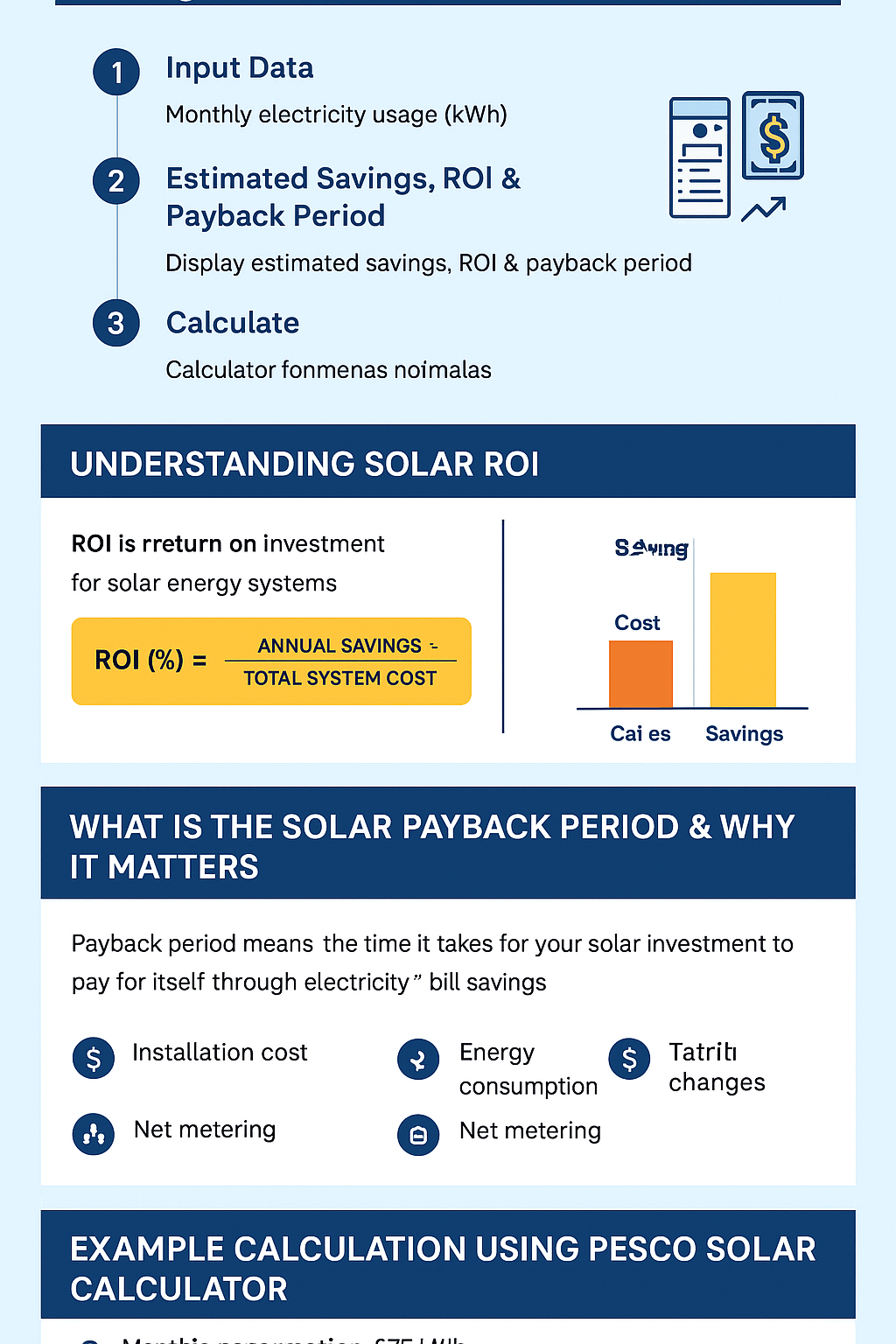
That’s where a PESCO Solar Calculator becomes a game-changer. This simple yet powerful tool helps you figure out exactly how much you can save by switching to solar, how quickly you’ll recover your investment (payback period), and what your return on investment (ROI) could look like over the years. It’s not just about numbers—it’s about seeing a clear path to energy savings and long-term electricity bill reduction.
With net metering in place, your solar panels can do more than just power your home—they can earn you credits by sending excess energy back to the grid. That means lower bills, faster payback, and greater independence from fluctuating electricity prices. In short, the PESCO Solar Calculator gives you the insight you need to make an informed, confident decision about going solar.
PESCO Solar Savings Estimator
Step-by-Step Guide: Using the PESCO Solar Calculator to Plan Your Savings in 2026
Thinking about switching to solar but not sure how much you’ll actually save? The PESCO Solar Calculator makes the math simple. In just a couple of minutes, you’ll see a clear picture of your potential energy savings, payback period, and ROI—all based on your own electricity usage.
Here’s how to make the most of it:
1. Find Your Monthly Electricity Usage (kWh)
Grab your latest PESCO bill and look for the “Units Consumed” section. This figure, usually in kilowatt-hours (kWh), tells the calculator exactly how much power you use. For example, if your bill shows 620 kWh, enter that number into the tool.
2. Enter Your Solar System Size (in kW)
Whether you’re planning to install solar or already have a system, type in its capacity—3 kW, 5 kW, 10 kW, or whatever applies. The calculator uses this to estimate how much power your panels can generate every month under local conditions.
✅ Monthly Bill Reminder Service: Never miss a payment
3. Add the Current PESCO Tariff Rate
Check your bill for the price you’re paying per unit of electricity (PKR/kWh). For example, if it’s Rs. 45 per kWh, that’s the figure you’ll enter. This helps the calculator work out your solar cost savings based on real PESCO tariff rates.
4. Include Net Metering Buy-Back Rates
If you’re eligible for net metering, you can earn credits for sending surplus power back to the grid. Simply enter the rate (PKR/kWh) that PESCO pays you. This ensures your savings forecast includes both bill reductions and extra earnings.
✅ Quick PESCO Bill Payment: Save time with online options
5. Calculate & Review Your Results
Hit the calculate button and watch the numbers work their magic. You’ll instantly see:
-
How much your monthly bill could drop.
-
Your annual savings in PKR.
-
The payback period—how many years before your solar setup has paid for itself.
-
Your projected Return on Investment over the system’s lifespan.
Example:
Let’s say you use 600 kWh/month, install a 5 kW solar system, and get paid Rs. 20/kWh for exported power. You could potentially eliminate your electricity bill and even earn credits from PESCO—saving hundreds of thousands of rupees over the next decade.
➡️ Simplify billing with the PESCO industrial bill check online system
So, how exactly does the PESCO Solar Calculator turn your electricity data into clear savings insights?
It’s simpler than you might think.
First, you’ll enter your monthly electricity usage—usually measured in kilowatt-hours (kWh). This figure comes straight from your PESCO bill and is the key to understanding your actual energy usage metrics. Next, you’ll add the system size you’re considering (for example, a 5 kW or 10 kW solar setup) along with the installation cost quoted by your solar provider.
Once these inputs are in, the calculator works behind the scenes to project your solar cost savings over time. The output shows you:
-
Estimated Annual Savings – how much you’ll save each year based on current tariff rates.
-
ROI % (Return on Investment) – the percentage return you can expect on your solar investment.
-
Payback Period (in years) – the number of years it will take to recover your initial cost.
For example, the payback period formula is straightforward:
Payback Period = System Cost ÷ Annual Savings
If your solar setup costs PKR 1,200,000 and you save PKR 200,000 per year, your payback period is 6 years—after that, you’re essentially producing electricity for free.
By combining real-world tariff data from PESCO with your personal consumption patterns, the calculator gives you an accurate, personalized forecast—making it easier to decide whether now is the right time to switch to solar.
➡️ Check your electricity cost before your bill arrives using PESCO tool
✅ Utility Payment Portals: Track Bills Efficiently
Understanding ROI (Return on Investment) in Solar
When you hear the term ROI—or Return on Investment—it’s just a way of asking, “How much will I get back for every rupee I put in?” In the case of solar, it’s about measuring how your solar panel investment pays you back over time through electricity bill savings and possible earnings from net metering.
Think of it like this: every month you’re not paying PESCO for electricity, you’re keeping money in your pocket. Add in the credits from sending surplus power back to the grid, and you’ve got a steady return that keeps adding up year after year.
✅ Estimate Your PESCO Load: Quick & Precise
How ROI Works with PESCO’s Tariff Structure
PESCO’s tariff rates (PKR/kWh) form the foundation of your ROI calculation. The higher the rates, the more you save each month by producing your own power. If tariffs rise over the years—as they usually do—your savings increase even faster, improving your ROI.
The basic ROI formula for solar looks like this:
ROI (%) = (Annual Savings ÷ Total System Cost) × 100
And to find your breakeven point—the time it takes to recover your initial investment—you simply divide the total cost of your solar system by your annual savings.
Example: ROI Over 25 Years
Let’s say:
-
System Cost: Rs. 1,200,000
-
Annual Savings: Rs. 200,000 (based on current PESCO tariff rates and your usage)
Your Payback Period = Rs. 1,200,000 ÷ Rs. 200,000 = 6 years
That means after year 6, your system has paid for itself—and every rupee saved from that point on is pure profit. Over a 25-year panel lifespan, you could be looking at:
Total Savings = Rs. 200,000 × 19 years = Rs. 3,800,000
And that’s not even counting tariff increases, which could push your savings even higher.
What Is the Solar Payback Period & Why It Matters
The solar payback period is simply the time it takes for your solar investment to “pay for itself” through the electricity bill savings it generates. In other words, it’s the moment you hit your breakeven point—when the money you’ve saved matches the amount you spent on your solar system. After that, every rupee you save is pure profit.
Think of it like buying a fruit tree. At first, you spend money planting and caring for it. But once it starts producing fruit year after year, it keeps giving back without costing you more. Your solar system works the same way—only instead of mangoes, it’s giving you free electricity.
✅ Quick Bill Lookup: Retrieve your old PESCO bills
Factors That Affect Your Payback Time
-
Installation Cost – A lower upfront cost shortens your payback period.
-
Energy Consumption – The more electricity you use (and offset with solar), the faster you reach breakeven.
-
Tariff Changes – If PESCO’s tariff rates rise over time, your savings grow, speeding up the payback.
-
Net Metering Benefits – Selling extra power back to the grid through net metering can significantly cut your payback time.
-
Government Incentives – Subsidies or rebates can reduce the initial cost, helping you recover your investment sooner.
Typical Payback Period in the PESCO Region
For most homes in PESCO’s service area, the payback time calculation works out to somewhere between 6 and 10 years. This range depends on factors like system size, local sunlight conditions, energy usage, and whether you’re taking advantage of net metering benefits.
Once you cross that threshold, you can look forward to 15+ years of free, clean electricity—turning your solar panel investment into a long-term source of savings.
✅ Electricity Load Calculator: Plan your power usage
Factors That Influence Your Solar Savings
Not all solar setups deliver the same savings. The amount you keep in your pocket depends on a mix of financial, technical, and policy factors. Understanding these can help you maximize your solar ROI and shorten your payback period.
1. Electricity Rates
Your current PESCO tariff—and how it changes over time—plays a huge role. When electricity prices go up (as they often do), your solar cost savings grow automatically, making your investment more valuable each year.
2. Government Incentives & Rebates
Certain solar incentives or subsidies can lower your upfront cost significantly. By reducing the initial investment, these rebates shorten your breakeven time and improve your long-term returns.
3. Net Metering Benefits
Through PESCO’s buyback plan, you can earn credits for the surplus energy you send back to the grid. These net metering benefits can slash your bills—or even earn you a profit—especially during sunny months.
4. System Size & Efficiency
The more energy your system produces, the more you save. High-quality solar panels paired with an efficient inverter will generate more power and last longer, boosting your lifetime savings. Choosing the right system size ensures you’re meeting your actual energy demand without overspending.
5. Maintenance Costs
Solar systems are low-maintenance, but not maintenance-free. Regular cleaning, periodic inspections, and eventual inverter replacement can affect your net savings. The good news? These costs are relatively small compared to your overall gains.
Example Calculation Using the PESCO Solar Calculator
Below is a simple, real-feel example you can paste into your blog to show readers how the PESCO Solar Calculator turns their inputs into clear savings, ROI, and payback figures. It’s written in a friendly, human tone and uses SEO-friendly phrases like solar savings calculator, installation cost breakdown, and electricity rate comparison.
Quick scenario (assumptions)
-
Monthly consumption: 600 kWh
-
System size: 5 kW
-
Expected generation per kW: 4.5 kWh/day (local average — adjust per your location)
-
PESCO tariff: Rs. 45 / kWh
-
Net metering buy-back rate: Rs. 20 / kWh
-
Installation cost (all-in): Rs. 1,200,000
-
Assumes no financing, no panel degradation, and maintenance not included (we’ll note those later).
Step-by-step walkthrough (what the calculator does)
-
Estimate monthly generation
Generation = system size × generation per kW/day × days per month
= 5 kW × 4.5 kWh/day × 30 days = 675 kWh / month -
Match generation with consumption
-
Consumption = 600 kWh/month
-
Generation = 675 kWh/month
-
Energy used at home (offset) = 600 kWh
-
Surplus exported to grid = 75 kWh
-
-
Calculate monthly savings & earnings
-
Savings from offset = 600 kWh × Rs. 45 = Rs. 27,000 / month
-
Earnings from export = 75 kWh × Rs. 20 = Rs. 1,500 / month
-
Total monthly benefit = Rs. 28,500
-
-
Annualize & compute payback / ROI
-
Annual savings = Rs. 28,500 × 12 = Rs. 342,000 / year
-
Payback period = Installation cost ÷ Annual savings
= Rs. 1,200,000 ÷ Rs. 342,000 ≈ 3.51 years -
Annual ROI = (Annual savings ÷ Installation cost) × 100 ≈ 28.5%
-
-
Lifetime (25-year) snapshot
-
Total savings over 25 years = Rs. 342,000 × 25 = Rs. 8,550,000
-
Net profit (25 yrs) = Total savings − Installation cost = Rs. 7,350,000
-
Results table
| Item | Value | Notes |
|---|---|---|
| Monthly generation | 675 kWh | 5 kW × 4.5 kWh/day × 30 |
| Monthly offset (used at home) | 600 kWh | Equals monthly consumption |
| Monthly exported | 75 kWh | Sells to grid via net metering |
| Monthly savings (offset) | Rs. 27,000 | 600 × Rs. 45 |
| Monthly earnings (export) | Rs. 1,500 | 75 × Rs. 20 |
| Total monthly benefit | Rs. 28,500 | Savings + earnings |
| Annual savings | Rs. 342,000 | ×12 |
| Installation cost | Rs. 1,200,000 | All-in estimate |
| Payback period | ~3.51 years | Cost ÷ Annual savings |
| Annual ROI | ~28.5% | Annual savings ÷ Cost |
| 25-year total savings | Rs. 8,550,000 | 25 × annual savings |
Notes & caveats
-
Generation per kW/day varies by location, tilt, and shading—swap the 4.5 figure with local data for more accuracy.
-
Tariff changes, maintenance, financing costs, inverter replacement, and panel degradation will affect real-world payback & ROI. Consider adding a sensitivity table (e.g., tariff +5% / −5%, generation ±10%) for readers who want a deeper comparison.
-
This example ignores fixed monthly charges and taxation—include those if you want a conservative estimate.
✅Peak Usage Cost Estimator: Find your monthly bill impact
Tips to Maximize Your Solar ROI
Investing in solar is a smart move, but getting the best return on investment (ROI) means going beyond just installing panels. The right choices in system efficiency, usage habits, and setup can push your savings higher and your payback period lower.
1. Choose High-Efficiency Solar Panels
Not all panels are created equal. Opt for high-efficiency models with low panel degradation rates (0.3–0.5% per year if possible). This means they’ll produce more energy for longer, keeping your annual returns strong even after 20–25 years.
2. Optimize Panel Placement
Make sure your panels get maximum sunlight exposure year-round. This usually means a south-facing orientation (in Pakistan) with the right tilt angle. Avoid shading from trees, nearby buildings, or other obstructions that can cut generation by 10–30%.
3. Consider Battery Storage
A solar battery backup lets you store excess energy for nighttime use or power outages. In areas with frequent load-shedding, this not only adds convenience but also increases your annual energy usage reduction—and in some cases, boosts ROI by reducing grid reliance.
4. Use Energy-Efficient Appliances
Lowering your energy demand means your solar system covers more of your usage. Replace old appliances with energy-efficient models, switch to LED lighting, and use smart timers or motion sensors to cut wastage. This small change can have a big impact on your system efficiency and long-term savings.
Common Mistakes to Avoid When Estimating Solar Payback
Calculating your solar payback period is exciting—you get to see when your investment will start paying for itself. But small oversights can make the numbers look better on paper than they are in reality. Here are the most common solar payback miscalculations to watch out for, so your real ROI matches your expectations.
1. Ignoring Maintenance Costs
Even though solar systems are low-maintenance, they’re not maintenance-free. Cleaning panels, inspecting wiring, and replacing the inverter every 8–12 years cost money. If you don’t include these in your calculations, your actual payback could be longer than expected.
2. Not Accounting for Panel Degradation
Solar panels lose efficiency over time—usually around 0.5% per year for most models. That means your system might produce 10–12% less power in its 25th year compared to year one. Always factor in degradation rates for a more accurate projection of your real ROI.
3. Overestimating Tariff Hikes
It’s tempting to assume electricity rates will skyrocket, which makes your savings look bigger. While tariffs do rise, they don’t always follow a steep curve. Use realistic projections from official sources or historical data to avoid inflated savings estimates.
4. Forgetting to Include Incentives
This one works both ways—some people forget to include government rebates, subsidies, or net metering credits in their payback calculations. These incentives can shave years off your breakeven point, so make sure they’re part of the math.
Bottom Line:
A well-calculated solar payback period should be grounded in reality, not just optimistic assumptions. By avoiding these mistakes, you’ll have a clearer picture of your real ROI vs. projected ROI, helping you make confident, profitable decisions.
Final Thoughts: Is Solar Worth It in the PESCO Region?
For most households and businesses in the PESCO region, the answer is a confident yes—solar power is absolutely worth it. With rising electricity tariffs, frequent load-shedding, and generous net metering benefits, installing a solar system isn’t just about going green—it’s about taking control of your energy costs.
Long-Term Savings
Switching to solar can drastically cut your energy bills, and once your system reaches its payback period, the electricity it produces is essentially free for the rest of its lifespan. Over 20–25 years, that adds up to huge financial savings.
Energy Independence
By generating your own power, you rely less on the grid and protect yourself from unpredictable tariff hikes. For areas prone to outages, pairing solar with battery storage can provide a steady, reliable source of electricity year-round.
Environmental Impact
Every unit of solar energy you produce replaces a unit that might have been generated from fossil fuels. That means fewer greenhouse gas emissions and a cleaner, healthier environment for future generations.
Next Step:
Before making your investment, run your numbers through the PESCO Solar Calculator. It’s the quickest way to see your potential solar ROI, payback period, and long-term solar investment benefits. With accurate data, you can make a decision that’s good for your wallet, your home, and the planet.
Ready to See Your Solar Savings?
You’ve read the facts, explored the benefits, and learned how to calculate your solar ROI—now it’s time to see the numbers for yourself.
Use our PESCO Solar Calculator Tool (right here on this page) to find out:
-
How much you can save each month
-
Your exact payback period
-
Your projected long-term energy bill savings
Also Check PESCO Bill Calculator
Take the Next Step:
Once you’ve got your numbers, reach out to certified solar installers in the PESCO region. They can help design a system tailored to your home’s needs, handle the net metering process, and ensure your investment delivers maximum returns.
The sooner you start, the sooner your solar system starts paying for itself—while powering your home with clean, renewable energy.