
When it comes to powering your home, knowing your load requirement is like knowing the fuel your car needs — it’s essential for smooth, safe, and efficient operation.
In simple terms, your home’s load requirement is the total amount of electricity your appliances, lighting, and equipment demand at any given time.
For homeowners in PESCO’s service area, this number isn’t just a matter of convenience — it’s directly tied to sanctioned load limits set by the Peshawar Electric Supply Company. Staying within these limits helps prevent tripping breakers, overheating wires, and the dreaded overloading penalties.
More importantly, it ensures your home’s wiring and service panel can handle your daily energy use without compromising safety.
By accurately calculating your load requirement, you’re not just following regulations — you’re protecting your home, your appliances, and your family.
Whether it’s running your air conditioner during the summer, charging an electric vehicle, or simply making sure your lights stay on during peak hours, a correct load estimation keeps everything running smoothly. Think of it as the roadmap to a safe, cost-efficient, and PESCO-approved electrical setup.
Load Requirement Calculator
PESCO Load Requirement Calculator
Notes & Tips
- Values are estimates. Confirm with a certified electrician for final wiring & permits.
- If recommended main breaker > 63A, consider three-phase supply.
- Motor loads (pumps, AC) may require higher start currents — sizing includes a safety factor.
Results
Backup & Wiring Recommendations
➡️ Check and download your PESCO electricity bill online anytime
How to Fill Out the Load Requirement Calculator Fields
1️⃣ Appliance – Enter the name of the electrical device you want to include in your calculation, such as Fan, LED Bulb, Refrigerator, Air Conditioner, or any other household appliance.
2️⃣ Wattage (W) – This is how much electricity the appliance uses per hour, measured in watts. You can find this information on the appliance’s label or in its user manual.
Example: Fan = 75W, LED Bulb = 12W.
3️⃣ Qty (Quantity) – Enter how many units of that appliance you have in your home.
Example: If you have 3 ceiling fans, type 3.
4️⃣ Hours/Day – The number of hours you use that appliance each day.
Example: Fan = 8 hours/day, LED Bulb = 5 hours/day.
5️⃣ X (Delete) – Click this button if you want to remove an appliance from your list. This is useful if you’ve made a mistake or no longer want to include that device in your PESCO load calculation.
➡️ Latest PESCO industrial bill check online portal for businesses
Interface Guide — PESCO Load Requirement Calculator
1. Appliance
What it means: This is where you enter the name of the electrical item you want to include in your calculation.
Examples:
-
Ceiling Fan
-
LED Bulb
-
Refrigerator
-
Washing Machine
-
Air Conditioner
Why it matters: Listing each appliance helps you clearly see what’s included in your total home load.
2. Wattage (W)
What it means: The amount of electricity your appliance consumes per hour, measured in watts.
Where to find it: Check the appliance’s sticker/label, user manual, or the manufacturer’s website.
Examples:
-
Fan: 75 W
-
LED Bulb: 12 W
-
Refrigerator: 200 W
Pro Tip: If you’re unsure, use an estimated value — but for the most accurate PESCO load calculation, go with the exact wattage.
✅ Monthly PESCO Bill Updates: Quick and reliable
3. Qty (Quantity)
What it means: The number of identical appliances you have in your home.
Examples:
-
3 ceiling fans → enter 3
-
1 washing machine → enter 1
4. Hours/Day
What it means: The average number of hours you use that appliance each day.
Why it matters: The longer you use it, the more it impacts your daily energy consumption and total load.
Examples:
-
Fan in summer: 8 hours/day
-
LED bulb in hallway: 5 hours/day
-
Refrigerator: 24 hours/day
✅ PESCO Payment Portal: Manage and pay bills anytime
5. Diversity Factor (%)
What it means: An adjustment that assumes not all appliances run at full power at the same time.
Default setting: 75% (meaning you assume only 75% of the total load is used at once).
Why it’s important: Prevents overestimating your load, making the calculation more realistic.
6. Safety Margin (%)
What it means: Extra load capacity added for future expansion or unexpected electricity usage.
Default setting: 25%.
Example: If your design load is 4.0 kW, adding a 25% margin gives you 5.0 kW capacity.
Pro Tip: Always keep some margin so your wiring and breaker panel can handle new appliances later.
✅ Past Bill Archive: Secure access to PESCO history
7. Results Section
Total Load:
-
The sum of all appliances’ power use, shown in kilowatts (kW).
-
Formula: Total Watt-hours ÷ 1000 = kW.
Design Load:
-
Your total load, adjusted with the Diversity Factor and Safety Margin.
-
Formula: Design Load = Total kW × (Diversity Factor %) × (1 + Safety Margin %).
Pie Chart:
-
A simple visual showing how much each appliance contributes to the total.
-
Helps you spot the biggest power consumers in your home.
✅ Fast & easy electricity cost estimation with PESCO Bill Calculator
8. + Add Appliance Button
What it does: Adds a new row so you can enter another appliance.
User Tip: Add one row per appliance type for the clearest results.
9. X Button (Remove)
What it does: Deletes an appliance from your list.
When to use: If you entered something by mistake or no longer want it in the calculation.
10. Download PDF
What it does: Generates a professional PDF report of your results for saving or printing.
Why it’s useful: Handy for electricians, engineers, or when you need to submit your load requirement to PESCO.
✅ PESCO Demand Estimator: Plan your electricity needs
Understanding Electrical Load Basics
Before you start crunching numbers with a PESCO load requirement calculator, it helps to understand a few basic terms you’ll see again and again — VA, Amps, and Voltage.
-
VA (Volt-Amps): Think of this as the total “power size” of your electrical demand. It’s like saying, “This is how much space your appliances take up in the electrical system.”
-
Amps (Amperes): This is the “flow” of electricity, much like the amount of water running through a pipe. Higher amps mean more current is moving.
-
Voltage (Volts): This is the “pressure” pushing electricity through the wires — in most Pakistani homes, that’s typically 230–240 volts.
Now, not all electrical loads behave the same way. That’s where continuous and intermittent loads come in:
-
Continuous load: Any device that runs for three hours or more at a time — like air conditioners, water pumps, or EV chargers. These need extra capacity because they keep pulling power for long stretches.
-
Intermittent load: Appliances you use in short bursts — like microwaves, hairdryers, or washing machines. These put demand on the system, but only for a short time.
So, how do we figure out the exact service size your home needs? That’s where NEC Article 220 load calculation comes in. This internationally recognized method breaks down your total power demand, applies demand factors, and ensures your home’s wiring and breaker panel can handle your lifestyle. For PESCO consumers, following these principles means your load estimate will align with sanctioned load limits — helping you stay safe, efficient, and fully compliant.
✅ Online Bill Platforms: Manage Your Utilities Easily
PESCO’s Role in Load Sanctioning
If you live in Peshawar or the surrounding areas, your electricity comes under the care of PESCO — the Peshawar Electric Supply Company. One of PESCO’s important jobs is to approve your sanctioned load, which is basically the maximum amount of electricity your home is officially allowed to draw from the grid.
Why does this matter? Because your sanctioned load determines:
-
The size of your main connection.
-
Your tariff category (and therefore your monthly bill structure).
-
The safety of your wiring and appliances.
For most households, the Residential Tariff A-1 applies when the sanctioned load is under 5 kW. This tariff is designed for typical homes with regular appliances like fans, lights, refrigerators, TVs, and maybe a small AC or two. Staying within this range means you’ll enjoy lower fixed charges and simpler billing.
If your load goes beyond this limit — for example, if you add multiple large air conditioners, an electric water heater, or an EV charger — you may need to apply for a higher sanctioned load and possibly move to a different connection type.
That’s also where single-phase vs three-phase comes in:
-
Single-phase connection: Standard for smaller homes with lower load requirements (generally up to 7–8 kW).
-
Three-phase connection: Suitable for larger houses, heavy appliances, and high-power equipment. It distributes electricity more evenly, reduces voltage drops, and handles higher loads without strain.
By accurately calculating your load and aligning it with PESCO’s sanctioned load policies, you not only stay compliant but also protect your electrical system from overloads — ensuring safe, efficient, and cost-effective power use.
✅ PESCO Bill Calculator: Calculate cost during peak hours
Components of a Home Electrical Load
When you calculate your home’s electrical load, you’re essentially adding up every source of power demand under your roof. Understanding each component helps you get a more accurate PESCO load calculation and avoid surprises later. Here’s what typically goes into the mix:
1. General Lighting Load
Your home’s lighting isn’t just about bulbs — it’s a key part of your total load. The standard method uses VA (Volt-Amps) per square foot to estimate how much electricity your lighting will consume. This includes ceiling lights, wall fixtures, and even decorative lighting.
2. Small Appliance Circuits
Kitchens, living rooms, and other active areas need at least two dedicated small appliance circuits, each rated at 1500 VA. These power items like kettles, blenders, and toasters, which might be small but pack a high wattage punch when in use.
3. Laundry Circuit
Laundry rooms require their own dedicated circuit rated at 1500 VA. This ensures your washing machine and related appliances get the power they need without overloading other circuits.
4. Nameplate Ratings for Appliances
Every large appliance — from your air conditioner and refrigerator to your washing machine and electric range — comes with a nameplate that shows its exact power usage in watts or VA. Using these values gives your load calculation real-world accuracy instead of relying on rough estimates.
5. EV Charging Load (Continuous Load)
If you own an electric vehicle, your charger is considered a continuous load, meaning it runs for three hours or more at a time. According to the 125% rule, you must size this load by multiplying its nameplate rating by 1.25 to ensure your wiring and breaker panel can handle the demand safely.
By including all these components in your PESCO load requirement calculator, you’ll have a clear, accurate picture of your home’s total energy needs — and a design that’s both safe and future-ready.
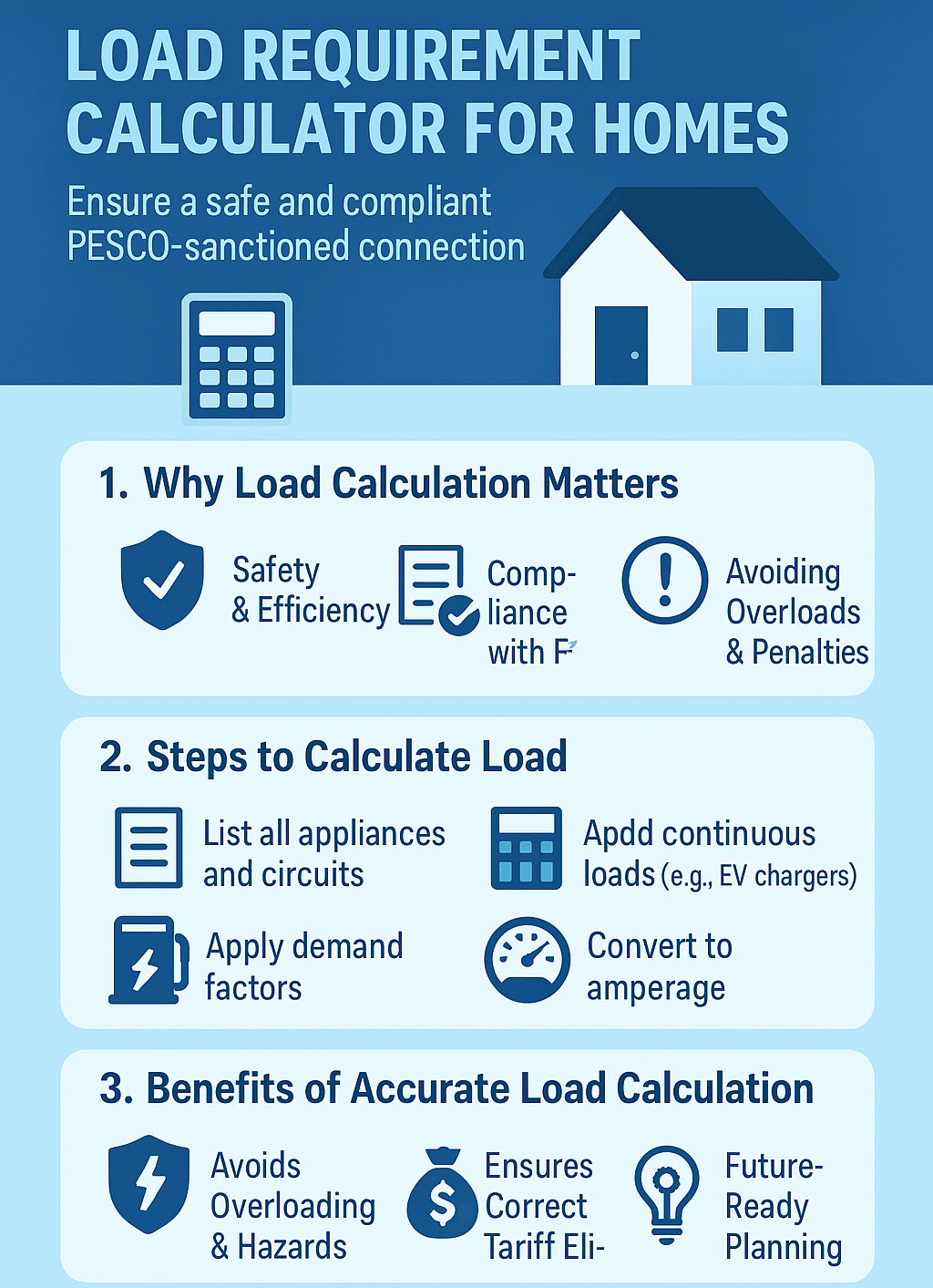
Step-by-Step Load Calculation Guide
-
List All Appliances and Circuits
-
Create a table of all appliances and fixed loads (lighting, fans, air conditioners, water pumps, kitchen equipment, etc.).
-
Include their wattage or volt-ampere (VA) rating.
-
-
Apply Demand Factors (NEC/PESCO methodology)
-
First 3000 VA is taken at 100%.
-
Remaining load (above 3000 VA) is taken at 35% to account for diversity.
-
-
Identify Continuous Loads
-
Continuous loads (operating for 3+ hours, e.g., EV chargers, water heaters, commercial lighting) must be multiplied by 125% before adding to the total.
-
-
Add All VA Values Together
- Sum adjusted VA values from steps 2 and 3 to get the total calculated load.
-
Convert VA to Amperage
-
Divide total VA by 240 V (single-phase) or by √3 × Voltage (for three-phase systems) to get total amperage.
-
-
Compare with PESCO Sanctioned Load Categories
-
Match the calculated load with PESCO’s load categories to determine the appropriate sanctioned load for your connection application or upgrade.
-
➡️ Calculate your electricity cost savings using the PESCO Solar Calculator
PESCO Electrical Load Calculation Table
| Appliance / Equipment | Quantity | Rated Power per Unit (Watts) | Total Power (Watts) | Diversity Factor (%) | Adjusted Load (Watts) | Remarks |
|---|---|---|---|---|---|---|
| Tube Light / LED Light | 100 | |||||
| Ceiling Fan | 100 | |||||
| Exhaust Fan | 100 | |||||
| Air Conditioner (1 Ton) | 100 | |||||
| Air Conditioner (2 Ton) | 100 | |||||
| Refrigerator | 100 | |||||
| Deep Freezer | 100 | |||||
| Water Motor / Pump | 100 | |||||
| Washing Machine | 100 | |||||
| Microwave Oven | 100 | |||||
| Electric Iron | 100 | |||||
| Electric Heater | 100 | |||||
| Geyser (Electric) | 100 | |||||
| Other Appliances | ||||||
| Total |
Quick Usage Steps for PESCO Compliance:
-
Fill Quantity for each appliance.
-
Enter the rated power per unit (usually mentioned on the device label).
-
Multiply Quantity × Rated Power to get Total Power (Watts).
-
Apply Diversity Factor as per PESCO’s standard (commonly 100% for domestic unless specified otherwise).
-
Add up the Adjusted Load column to get your Total Connected Load.
-
Ensure the total is within the sanctioned load for your tariff category.
Example Calculation — 5-Room Home
Given
-
General lighting: 3,000 VA
-
Small appliance circuits: 2 × 1,500 VA = 3,000 VA
-
Laundry circuit: 1,500 VA
-
EV charger (nameplate): 9,600 VA (continuous)
Step 1 — Build the general load
General load = Lighting + Small appliance + Laundry
= 3,000 + 3,000 + 1,500 = 7,500 VA
Step 2 — Apply demand factors to the general load
-
First 3,000 VA @ 100% = 3,000 VA
-
Remainder (7,500 − 3,000) = 4,500 VA @ 35% = 1,575 VA
Adjusted general load = 3,000 + 1,575 = 4,575 VA
Step 3 — Add continuous loads (EV) at 125%
EV charger = 9,600 VA × 1.25 = 12,000 VA
Step 4 — Total calculated load (VA)
Total VA = Adjusted general load + Adjusted continuous loads
= 4,575 + 12,000 = 16,575 VA (≈ 16.58 kVA)
Step 5 — Convert to service amperage (single-phase)
Use I = VA ÷ V
-
At 240 V: 16,575 ÷ 240 = 69.06 A → ~69 A
-
(For reference at 230 V: 16,575 ÷ 230 = 72.07 A → ~72 A)
Result: Your calculated service current is roughly 69–72 A depending on whether your system is treated as 240 V or 230 V.
Step 6 — Compare with PESCO sanctioned load
-
~16.6 kVA (~16.6 kW assuming PF ≈ 1) is well above 5 kW (Residential A-1).
-
Practically, this level of load typically exceeds single-phase comfort and may warrant a three-phase connection and a higher sanctioned load category.
Tip: If you plan future additions (another AC, bigger EVSE, etc.), consider adding a safety margin (e.g., +25%):
16,575 × 1.25 = 20,719 VA → at 240 V ≈ 86.3 A.
This helps you and your electrician choose an appropriately sized main breaker/panel and apply for a suitable PESCO sanctioned load.
Quick Recap
General load (raw): 7,500 VA
-
General load (after demand factors): 4,575 VA
-
EV charger (9,600 VA × 125%): 12,000 VA
-
Total: 16,575 VA (~16.6 kVA)
-
Service current: ~69 A @ 240 V (≈ 72 A @ 230 V)
-
Sanctioned load implication: Above 5 kW A-1 → likely needs higher sanctioned load and three-phase.
Avoiding the Most Common Load Estimation Mistakes
Load estimation isn’t just about adding up a few numbers—it’s about ensuring your electrical system runs safely, efficiently, and in compliance with PESCO requirements. Unfortunately, many people make small mistakes that lead to big problems, from unexpected power trips to overloaded circuits and higher electricity bills. Here are some pitfalls you should steer clear of:
1. Forgetting to Include Every Appliance
Many homeowners and even contractors overlook small devices like chargers, water pumps, or kitchen appliances. These “forgotten” loads can add up, throwing off your entire connected load calculation and leading to underestimation of capacity.
2. Ignoring Demand Factors
Not every appliance runs at the same time, but demand factors help you calculate a realistic load. Ignoring them can result in either over-sizing your supply (wasting money) or under-sizing it (causing frequent overloads).
3. Treating Continuous Loads as Intermittent
Appliances like air conditioners, refrigerators, or commercial lighting run for long periods and should be treated as continuous loads. Misclassifying them can lead to overheating of wiring and breaker trips.
4. Not Aligning with PESCO Tariff and Load Guidelines
Even if your calculations are correct, they need to match PESCO’s tariff categories, load limits, and connection requirements. Skipping this step can cause application rejections or delays in new connections and load extensions.
Benefits of Accurate Load Calculation
-
Avoids Overloading & Hazards: Prevents tripping, fire risks, and damage to wiring.
-
Ensures Correct Tariff Eligibility: Keeps you in the right consumer category, avoiding penalties.
-
Future-Ready Planning: Makes it easy to add high-consumption devices like EV chargers or new ACs without redoing the whole setup.
Tools & Resources
-
PESCO Online Load Requirement Calculator – A quick way to estimate your home’s total load and ensure it aligns with PESCO’s sanctioned limits.
-
PESCO Official Guidelines – Visit the official PESCO website for the most up-to-date sanctioned load policies and application procedures.
-
NEC Article 220 – A key reference from the National Electrical Code for calculating residential electrical loads accurately and safely.
FAQs – Load Requirement Calculator for Home (PESCO)
Q1. What is a Load Requirement Calculator for Home in PESCO?
A Load Requirement Calculator is a tool that helps you estimate the total electrical load of your home, measured in kilowatts (kW) or kilovolt-amperes (kVA), to meet PESCO’s sanctioned load requirements.
Q2. Why do I need to calculate my home’s load for PESCO?
PESCO requires consumers to declare their sanctioned load for safety, billing, and transformer capacity planning. Correct load calculation ensures proper wiring, breaker size, and avoids penalties for overloading.
Q3. How do I use the PESCO load calculator?
You simply select or input the quantity and wattage of each appliance in your home. The calculator automatically totals the load and converts it into kW and kVA based on PESCO’s standard power factor.
Q4. What is the standard power factor used by PESCO?
For residential consumers, PESCO typically uses a power factor of 0.90 for load calculation purposes, unless otherwise specified.
Q5. What appliances should I include in my calculation?
Include all major appliances such as lights, fans, air conditioners, refrigerators, washing machines, water pumps, geysers, microwaves, and other high-consumption devices.
Q6. What happens if my actual load exceeds the sanctioned load?
If your consumption exceeds the sanctioned load, PESCO can impose penalties, require you to apply for load enhancement, or disconnect service in severe cases.
Q7. Can I increase my sanctioned load after installation?
Yes. You can apply to PESCO for sanctioned load enhancement by submitting an application, paying the relevant fees, and possibly upgrading your wiring and meter capacity.
Q8. Is the online calculator’s result final for PESCO approval?
No. The online calculator provides an estimate for your own planning. PESCO’s technical team will conduct their own verification before finalizing your sanctioned load.
Q9. Where can I find PESCO’s official load requirement guidelines?
You can visit the official PESCO website or contact your local PESCO subdivision office for detailed sanctioned load tables and NEC references.
Q10. Does this calculator work for both single-phase and three-phase connections?
Yes. You can use it for both types. However, for large loads (usually above 5 kW), PESCO may recommend or require a three-phase connection.
Conclusion
Getting your connected load right isn’t just about ticking a box on the PESCO application form—it’s about ensuring your electrical system is safe, efficient, and compliant with official regulations. An accurate load calculation helps you avoid unnecessary power trips, wiring issues, and surprise costs later down the road.
Before you apply for a PESCO new connection, take a few minutes to check your total load requirements. Our PESCO load calculator makes the process effortless—just enter your appliance details, and it instantly tells you the exact load you need to declare. This small step can save you hours of manual calculations, prevent application delays, and keep you fully aligned with PESCO connection rules.
Whether you’re setting up a new home, expanding a shop, or upgrading industrial equipment, knowing your correct load capacity is key to avoiding future headaches. Accurate calculation means you get the right meter, the right connection type, and the peace of mind that your setup is both safe and future-ready.
So, before you submit that application—double-check your load. It’s quick, smart, and could be the difference between a smooth approval and a frustrating back-and-forth with PESCO.