
Understanding Your PESCO Bill
If you’ve ever stared at your PESCO electricity bill wondering what all those charges mean, you’re not alone. Most consumers across Pakistan receive their monthly bills without truly understanding where their hard-earned money is going. This guide is here to help you make sense of it all — line by line, component by component.
PESCO, short for Peshawar Electric Supply Company, operates under the umbrella of WAPDA (Water and Power Development Authority). It serves as one of Pakistan’s major distribution companies, responsible for delivering electricity to millions of homes and businesses in Khyber Pakhtunkhwa and surrounding regions. But PESCO doesn’t generate electricity itself — instead, it buys electricity from national suppliers and distributes it to consumers like you, while following pricing and structural guidelines set by NEPRA.
Now, here’s where things get interesting — NEPRA (National Electric Power Regulatory Authority) is the official body that regulates electricity tariffs in Pakistan. It ensures that all distribution companies, including PESCO, charge fair and standardized rates. Every figure you see on your bill, from unit rates to fuel adjustments, is tied back to NEPRA’s approved framework.
So why should you care about your electricity bill breakdown?
Because understanding your bill not only helps you detect any billing errors or unusual charges, but it also empowers you to make smarter energy decisions — potentially lowering your monthly expenses. With a bit of knowledge, what once looked like a complicated list of numbers will begin to make perfect sense.
Let’s decode the PESCO bill together — starting with what each component means and why it’s there.
➡️ Plan your budget using PESCO Bill Calculator with exact breakdown
PESCO Bill Format: How to Read Your Bill
At first glance, your PESCO bill might seem like a maze of numbers and technical jargon — but once you know what each section means, it becomes surprisingly simple to understand. Every monthly bill follows a standardized format, carefully structured to give you all the essential details about your electricity usage, charges, and account status.
Let’s walk through the most important sections you’ll find on a typical PESCO bill:
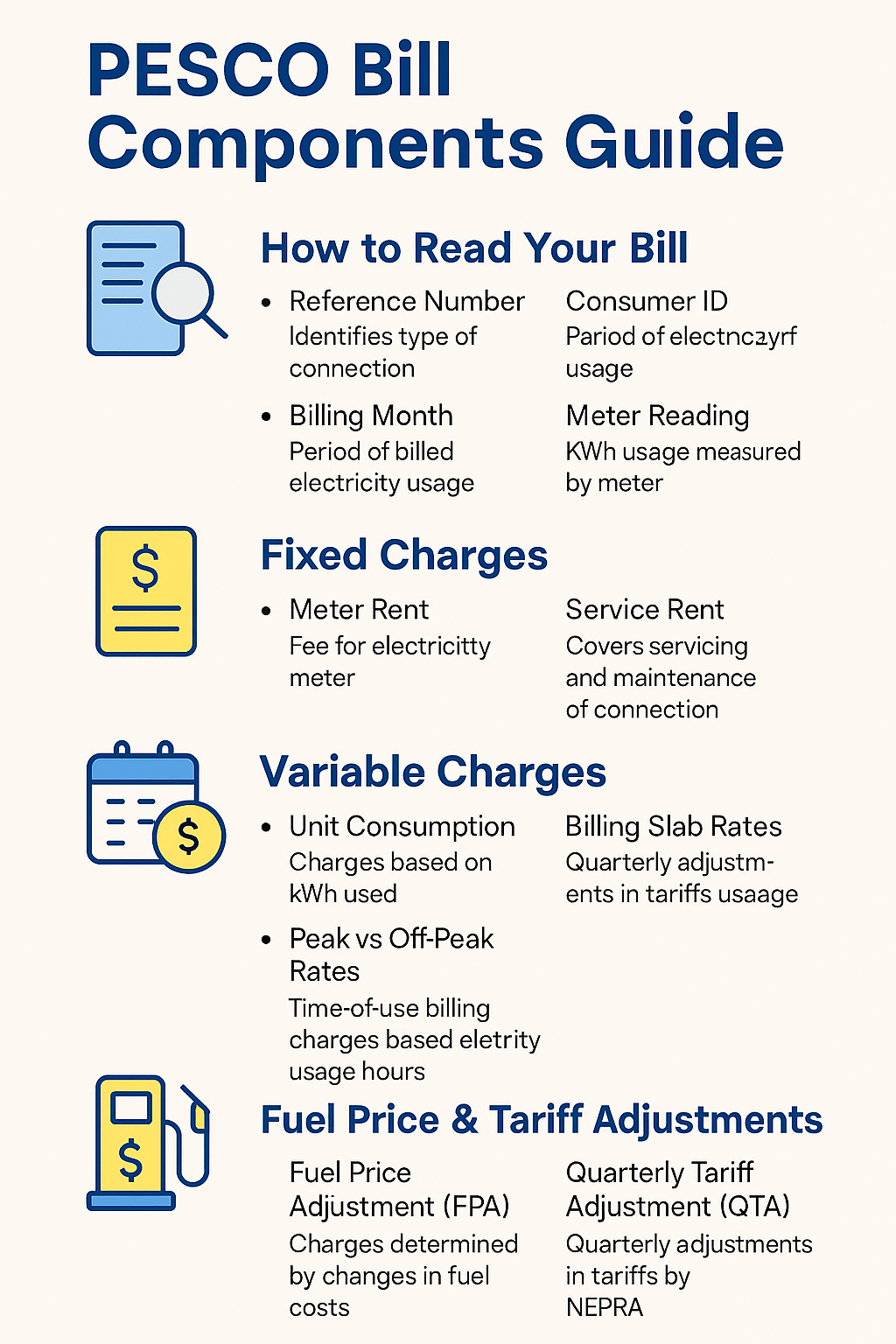
Reference Number
This is the most important identifier on your bill — your unique 14-digit reference number. It’s like the tracking ID of your electricity account and is required every time you check your PESCO bill online or lodge a complaint. You’ll find it at the top left or top right corner of your bill. Make sure to note this down or save a digital copy for quick access.
Consumer ID / Consumer Reference Number
Often confused with the reference number, the consumer ID (or consumer reference number) helps PESCO categorize your connection type — whether you’re a residential, commercial, or industrial user. This ID links your bill to your registered profile in PESCO’s database.
Billing Month
This tells you the time period for which your energy usage is being billed. It’s especially important if you want to compare usage from one month to another or cross-check your bill against meter reading dates.
Meter Reading & Schedule
Your electricity consumption is measured by your meter reading, which shows the number of kilowatt-hours (kWh) you’ve used. The meter reading schedule is usually set monthly, but some consumers may be billed bi-monthly depending on their category or location. Always compare the “Previous” and “Current” readings on the bill to verify how many units you’ve actually consumed.
Understanding these key sections allows you to take control of your electricity expenses. And if you’re ever in doubt, tools on platforms like PESCO-OnlineBill.pk make online bill interpretation a breeze — just enter your reference number, and you can instantly view or download your latest bill.
Fixed Charges on the PESCO Bill
Not everything in your WAPDA electricity bill is based on how many units you use. Some costs remain the same each month, no matter how carefully you manage your electricity consumption. These are known as fixed charges, and they play a crucial role in helping PESCO maintain its vast network of poles, wires, meters, and infrastructure.
Here’s a breakdown of the fixed charges in your PESCO bill that appear every month:
Meter Rent Charges
Even though your electricity meter might have been installed years ago, PESCO still charges a small monthly fee for it — this is called meter rent. It’s a standard charge meant to cover the maintenance, calibration, and eventual replacement of the meter if needed. While the amount is usually minimal, it’s one of the consistent figures on your bill regardless of how many units you use.
Service Rent
This is another common fixed charge that covers the cost of servicing and maintaining your electricity connection over time. It helps ensure that PESCO can respond to breakdowns, carry out system upgrades, and manage routine repairs across its distribution network. Like meter rent, this fee is fixed and does not change based on your energy consumption.
Distribution and Maintenance Charges
These charges help PESCO recover the cost of maintaining the distribution lines, substations, transformers, and technical support teams that keep the electricity flowing to your home or business. Even during months when your consumption is low, these charges ensure the network remains operational and ready to deliver uninterrupted power.
Although these fixed charges may seem small, they add up and form a consistent part of your PESCO bill. Understanding them can help you better analyze where your money goes and why some parts of your bill never change — even when you’re doing your best to conserve energy.
Next time you review your bill on PESCO-OnlineBill.pk, pay attention to these fixed items — they offer a clearer picture of the cost of keeping the lights on, even when you’re not using much electricity.
Variable Charges Based on Usage
Now let’s get into the part of your PESCO electricity bill that changes every month — the variable charges. These are directly linked to how much electricity you use during the billing cycle and can fluctuate based on your habits, appliances, and even the time of day you use them.
Understanding Unit Consumption
Every time you turn on a fan, light, or appliance, you consume electricity measured in kilowatt-hours (kWh). Your bill shows how many units (kWh) you’ve used in a given month. This unit consumption forms the basis of your variable charges. The more units you use, the more you pay.
Per kWh Unit Rate & Billing Slab Rates
PESCO doesn’t charge a flat rate for every unit you consume. Instead, it follows a slab-based billing structure, which means the unit price per kWh increases as your usage goes up. For example, the first 100 units might be charged at a lower rate, but once you cross that threshold, the next slab is billed at a higher rate — and so on.
These PESCO billing slab rates are designed to encourage energy conservation. Staying within a lower slab can significantly reduce your bill, while crossing into higher slabs can result in much steeper charges.
Peak vs Off-Peak (TOU) Rates – Time-of-Use Billing
If you have a Time-of-Use (TOU) meter, your bill becomes even more dynamic. TOU billing separates the day into peak and off-peak hours, with electricity being more expensive during peak demand times (typically evenings) and cheaper during off-peak periods (late nights or early mornings).
Using high-consumption appliances like air conditioners, water heaters, or irons during off-peak hours can help you save a good chunk on your monthly bill. It’s a smart move — both for your wallet and the energy grid.
Pro Tip: You can track your unit consumption and slab rate status each month using the PESCO Online Bill Check Tool — just enter your reference number, and all your usage data will appear instantly.
Fuel Price Adjustment (FPA)
Ever noticed a line on your PESCO bill labeled FPA and wondered what it means? You’re not alone. The Fuel Price Adjustment — or FPA — is one of the most talked-about and often misunderstood components on electricity bills across Pakistan.
What Is FPA and Why Does It Change Monthly?
The FPA charge reflects the cost difference in the fuel used to generate electricity. Since most of Pakistan’s electricity comes from fuel-based power plants, the cost of fuel (like furnace oil, gas, and imported coal) plays a big role in your monthly electricity rate.
When the international or domestic fuel prices go up, the cost of generating electricity also rises — and that difference is passed on to consumers in the form of FPA. The reverse is also true: if fuel prices drop, you might see a small reduction in this charge. That’s why the fuel price adjustment in PESCO bills varies from month to month.
Who Decides the FPA Rate?
FPA isn’t something randomly added. It’s officially calculated and approved by two key entities:
-
CPPA-G (Central Power Purchasing Agency – Guarantee): This agency compiles the actual cost of electricity purchased from different generation companies.
-
NEPRA (National Electric Power Regulatory Authority): NEPRA then reviews and approves the FPA rates and ensures they’re implemented fairly across all distribution companies, including PESCO.
So, when you see an FPA charge on your PESCO bill, know that it’s based on real-world fuel market conditions and regulated by the authorities.
Quick Tip: You can stay updated on the latest NEPRA-approved rates and monthly adjustments right here at PESCO-OnlineBill.pk, where we break down these changes in a simple and understandable format.
Quarterly Tariff Adjustment (QTA)
Just when you think you’ve figured out your electricity bill, another line shows up — Quarterly Tariff Adjustment (QTA). Don’t worry, you’re not being overcharged without reason. The QTA is a regulated part of your bill, and understanding it will help you make better sense of your electricity bill changes every few months.
What Is the QTA Component?
The Quarterly Tariff Adjustment (QTA) is a mechanism used by PESCO — and all other DISCOs — to balance the actual cost of supplying electricity over a three-month period. It adjusts your bill to reflect variations in the overall tariff structure, such as inflation, changes in fuel prices, capacity charges, and currency fluctuations.
This adjustment is added (or sometimes subtracted) once every three months, meaning you’ll typically see it in your bill four times a year.
Why Does It Change Every Quarter?
Unlike the monthly FPA, which focuses on fuel costs, the QTA covers a broader range of factors. These include changes in generation costs, distribution expenses, and even foreign exchange rates that impact power purchase agreements.
The government and regulatory authorities calculate these costs after the quarter ends, and then decide whether consumers were charged too much or too little. The resulting adjustment is reflected in future bills to balance the books.
Role of Government Subsidies and Surcharges
Sometimes the government steps in with subsidies to help lower-income or residential consumers absorb tariff hikes. On the flip side, if there’s a financial gap in the system, a surcharge might be added temporarily to recover costs.
So, your QTA charge may also include:
-
Tariff differential subsidies
-
Debt servicing surcharges
-
Rebates or relief adjustments
These decisions are often political and economic in nature, but they’re implemented through structured, regulated billing practices.
Bottom Line:
The QTA isn’t a random fee — it’s a part of the national power sector’s financial balancing act. Whether it’s a surcharge or a subsidy, it reflects real shifts in the electricity market and is overseen by authorities to ensure fairness and transparency.
To stay informed about upcoming quarterly tariff updates, check back regularly at PESCO-OnlineBill.pk, where we break down complex billing elements into simple language you can trust.
Taxes and Government Levies
Beyond the electricity you actually use, your PESCO bill includes a set of government-imposed taxes and levies. These are standard charges that apply to most consumers in Pakistan, and while they often go unnoticed, they can make up a noticeable portion of your total bill.
Here’s a simple breakdown of the most common PESCO bill taxes and duties you’ll see each month:
GST (General Sales Tax)
The GST on electricity bills is just like the sales tax you pay when you buy goods or services. It’s a government-mandated tax, currently set at a specific percentage based on your consumption level and connection type. The more units you use, the more GST you’ll see on your bill. This tax is collected by PESCO and forwarded to the federal government — it’s not a utility profit but a national tax obligation.
Electricity Duty
This is a provincial tax added to your bill, usually calculated as a small percentage of your total electricity charges. The electricity duty is meant to help the provincial government fund energy development and infrastructure projects. While it may seem minor on residential bills, it can be significant for large commercial and industrial users.
TV License Fee
Yes, even your television makes its way into the electricity bill! The TV fee is a fixed monthly charge added to your bill by the government to support Pakistan Television (PTV) and other state-run broadcasting services. It doesn’t matter whether you own a TV or not — this fee is mandatory and charged per connection.
Why These Charges Matter
Understanding these components is essential because they’re not tied to your energy use. Even if you dramatically reduce your unit consumption, these fixed government levies will still appear. Being aware of them can help you better analyze your bill and plan your monthly expenses accordingly.
Need help understanding your tax charges?
You can use our bill breakdown tool at PESCO-OnlineBill.pk to see a clear summary of your GST, TV fee, and electricity duty, all in one place — no confusion, no surprises.
Common Questions About PESCO Bill Charges
If you’ve ever opened your PESCO electricity bill and thought, “Wait, why is this so high?”, you’re not alone. These are some of the most frequently asked questions from consumers across Pakistan — and the good news is, we’ve got clear answers to help you make sense of your bill and take control of your electricity usage.
Why is my PESCO bill so high this month?
There could be several reasons why your electricity bill suddenly spikes. The most common causes include increased unit consumption due to hot weather (fans, ACs, refrigerators running longer), crossing into a higher billing slab, or a hike in fuel price adjustment (FPA) rates. Additionally, delays in meter reading can also lead to longer billing cycles, which means more units bundled into one bill. Always check your meter reading and billing month carefully to be sure.
What is fuel adjustment on the bill?
The fuel adjustment or Fuel Price Adjustment (FPA) reflects changes in the cost of generating electricity. If the cost of fuel used by power producers goes up, the difference is passed on to you through FPA. These charges are reviewed and approved by NEPRA and vary from month to month. You can find them clearly labeled on your PESCO bill.
Can I reduce my electricity bill?
Absolutely. Small changes in your daily habits can lead to noticeable savings. Start by shifting heavy appliance use to off-peak hours (if you’re on a TOU meter), unplug devices when not in use, and keep an eye on monthly consumption to avoid higher PESCO billing slab rates. Staying below higher slab thresholds can significantly reduce your unit price per kWh.
How to calculate PESCO electricity bill charges online?
If you want to know what your upcoming bill might look like, use the free calculator tool at PESCO-OnlineBill.pk. Just input your unit consumption and select your consumer type — the system will instantly estimate your total, including FPA, GST, electricity duty, and other charges. This helps you monitor usage before the bill even arrives.
Bonus: What are the components of a PESCO electricity bill?
Your bill includes both fixed charges (like meter rent and service fees) and variable charges (based on your energy use). Add to that taxes like GST, the TV fee, and quarterly or monthly adjustments like FPA and QTA. Knowing these components is the first step in understanding slab-based billing and managing your energy costs more effectively.
How NEPRA Affects Your PESCO Bill
Ever wondered who decides the electricity rates you’re paying each month? It’s not PESCO working behind closed doors — it’s NEPRA, the National Electric Power Regulatory Authority, and its decisions impact every line of your PESCO bill, from the unit rate per kWh to the fuel adjustments and beyond.
What Does NEPRA Do?
NEPRA is the official body responsible for overseeing power sector regulation in Pakistan. It sets the NEPRA electricity rates for all distribution companies, including PESCO, based on detailed cost-of-service models. This includes evaluating generation costs, fuel prices, infrastructure investments, and consumer affordability.
Every few months, NEPRA issues tariff notifications — official updates that approve or revise electricity rates. These changes are then applied to your bill in the form of new unit rates, FPA, or Quarterly Tariff Adjustments (QTA).
How Are National Fuel and Power Prices Connected?
Electricity in Pakistan is largely generated through fossil fuels like furnace oil, natural gas, and imported coal. As global and domestic fuel prices rise or fall, the cost of electricity generation changes too. NEPRA tracks these changes and adjusts billing structures accordingly. That’s why your bill may vary even if your unit consumption stays the same — it’s all tied to fuel price volatility.
Tariff Categories: Residential, Commercial, and Industrial
NEPRA also defines different tariff categories based on consumer type. Each category has its own slab rates, taxes, and billing structures:
-
Residential Users: Lower base rates and subsidized slabs to protect low-income households.
-
Commercial Users: Slightly higher rates with fewer slabs and limited subsidies.
-
Industrial Users: Customized tariffs based on load demand, peak-hour usage, and energy efficiency.
Your PESCO tariff category is determined when your connection is first registered — but it can be updated if your usage pattern or property purpose changes.
Why This Matters
Knowing how NEPRA operates helps you understand why your PESCO bill fluctuates, even without any change in consumption. It also empowers you to explore whether you’re in the right tariff category for your needs, especially if you run a business or use heavy machinery at home.
To stay updated on NEPRA’s latest notifications, visit PESCO-OnlineBill.pk where we simplify technical updates into bite-sized insights you can actually use.
Tips to Reduce Your PESCO Bill
Tired of seeing your electricity bill rise month after month? You’re not alone — and the good news is, a few smart changes in your daily routine can help you lower your PESCO bill without sacrificing comfort. Here’s how:
1. Monitor Your Monthly Usage
Keep track of your electricity consumption each month by reading your meter or checking your PESCO online bill regularly. When you monitor usage, you can spot unusual spikes early — like a faulty appliance or excessive AC use — and take action before the bill arrives.
⏰ 2. Shift to Off-Peak Hours
PESCO’s billing system often includes peak and off-peak hours. Running heavy appliances like washing machines, iron, or air conditioners during off-peak hours (usually late night or early morning) can reduce the unit rate you’re charged — especially if you’re on a time-of-use (TOU) meter.
3. Upgrade to Energy-Efficient Appliances
Investing in energy-saving appliances — such as inverter ACs, LED lights, or energy-star rated refrigerators — can significantly cut your monthly load. While these items may cost more upfront, the long-term savings on your electricity bill make them well worth it.
4. Understand the Slab System
PESCO uses slab-based billing rates, meaning the more units you consume, the higher the rate per unit. Crossing into a higher slab can drastically raise your bill. For example, jumping from 200 units to 301 units in a month can push you into a much more expensive bracket. Being mindful of your usage and staying within a lower billing slab rate can help you avoid these costly jumps.
✅ Bonus Tip: Turn Off Standby Devices
TVs, chargers, and even Wi-Fi routers consume electricity in standby mode. Use a power strip to shut everything off at once — it adds up to savings over time.
Pro Tip: Use an PESCO electricity usage calculator or the estimated bill feature on PESCO-OnlineBill.pk to test different consumption levels and see how small changes affect your monthly charges.
Conclusion: Take Control of Your PESCO Electricity Bill
Understanding your PESCO electricity bill isn’t just about reading numbers — it’s about gaining control over your energy costs and making smarter decisions. Each component on your bill — from the fuel price adjustment (FPA) to taxes and duties — reflects real policy decisions, consumption patterns, and national energy prices. The more informed you are, the easier it becomes to manage your electricity expenses and avoid unexpected charges.
We encourage all consumers to check their PESCO bill online regularly using the official billing portal or trusted platforms like PESCO-OnlineBill.pk. These services not only allow for easy online bill interpretation but also help you track consumption trends, identify overbilling, and stay updated on tariff changes.
If something looks off in your bill, don’t hesitate to start the complaint resolution process with PESCO. Addressing issues early helps avoid long-term discrepancies and keeps your records accurate.
In short, electricity bill awareness empowers you to save money, reduce consumption, and ensure transparency in your utility costs.