Comparison of PESCO with Other DISCOs | IESCO, LESCO & MEPCO Analysis
Electricity powers our daily lives, and in Pakistan, this essential service is managed by different electricity distribution companies (DISCOs). Each DISCO is responsible for delivering electricity to a specific region, ensuring smooth power supply, handling billing systems, and resolving customer complaints. Among these companies, PESCO (Peshawar Electric Supply Company) plays a vital role in serving millions of consumers in Khyber Pakhtunkhwa.
But why is it important to compare PESCO with other major DISCOs like IESCO, LESCO, and MEPCO? The reason is simple – not all distribution companies perform the same. Factors like operational efficiency, customer service, complaint resolution, load management, and tariff structures vary from one DISCO to another. By understanding these differences, consumers can get a clear picture of service quality and what improvements are needed.
In this article, we’ll take a closer look at how PESCO compares with other leading DISCOs in Pakistan. We’ll explore areas such as regional coverage, infrastructure strength, billing systems, outage management, and customer satisfaction, so you can see where PESCO stands in terms of reliability and performance.
✅ Duplicate and current PESCO bills can be checked online
What is PESCO and Its Role in Power Distribution?
PESCO, short for Peshawar Electric Supply Company, is one of the leading electricity distribution companies (DISCOs) in Pakistan. It operates under the supervision of NEPRA and WAPDA, ensuring a stable electricity supply to millions of consumers across Khyber Pakhtunkhwa (KPK). From bustling cities like Peshawar to remote rural areas, PESCO plays a crucial role in powering homes, businesses, and industries.
The primary responsibility of PESCO is to distribute electricity efficiently and maintain a reliable power network. This includes meter installations, bill generation, maintenance of distribution lines, and quick response to customer complaints. With a vast service area and diverse consumer base, PESCO’s operations demand strong infrastructure and round-the-clock monitoring.
However, like other DISCOs in Pakistan, PESCO faces several challenges. Load management remains a major concern, especially during peak demand seasons. Frequent power outages, line losses, and electricity theft add to operational difficulties. In addition, customer service and complaint resolution systems are areas where continuous improvement is needed to match consumer expectations.
Despite these hurdles, PESCO is working on modernization by introducing online billing systems, digital complaint registration, and smart metering projects to enhance service quality. The company’s efforts aim to provide a seamless experience for consumers and ensure a stable power supply across its entire network.
✅ Download and view your PESCO industrial bill online anytime
Overview of Other Major DISCOs in Pakistan
Pakistan’s power distribution network is divided among several DISCOs (Distribution Companies), each responsible for providing electricity to a specific region. Understanding these companies helps us see how PESCO compares with others in terms of service quality, coverage, and efficiency.
IESCO (Islamabad Electric Supply Company)
IESCO serves the capital city of Islamabad and surrounding areas, including Rawalpindi, Attock, Jhelum, and Chakwal. It is known for relatively better infrastructure and a strong urban distribution network, ensuring a more stable electricity supply compared to many other regions.
LESCO (Lahore Electric Supply Company)
LESCO manages electricity distribution in Lahore and nearby districts. Serving a large urban population, it faces challenges like high energy demand, peak load management, and maintaining service reliability. Rural areas under LESCO often experience more outages compared to urban zones.
✅ Get instant feedback on how reducing units saves you money
MEPCO (Multan Electric Power Company)
MEPCO operates in the southern Punjab region, covering the largest service area among all DISCOs. With a mix of urban and rural consumers, it faces issues like long-distance transmission losses, load shedding, and infrastructure maintenance.
Apart from these, Pakistan also has other important DISCOs:
-
FESCO (Faisalabad Electric Supply Company) – Industrial hub electricity supply.
-
GEPCO (Gujranwala Electric Power Company) – Serves central Punjab.
-
HESCO (Hyderabad Electric Supply Company) – Covers major Sindh regions.
-
QESCO (Quetta Electric Supply Company) – Supplies electricity to Balochistan.
-
SEPCO (Sukkur Electric Power Company) – Focused on northern Sindh areas.
-
K-Electric – Responsible for Karachi, the largest metropolitan city.
Each DISCO has its unique operational challenges and service strengths, which makes comparing them essential for identifying areas of improvement.
Regional Coverage and Service Areas
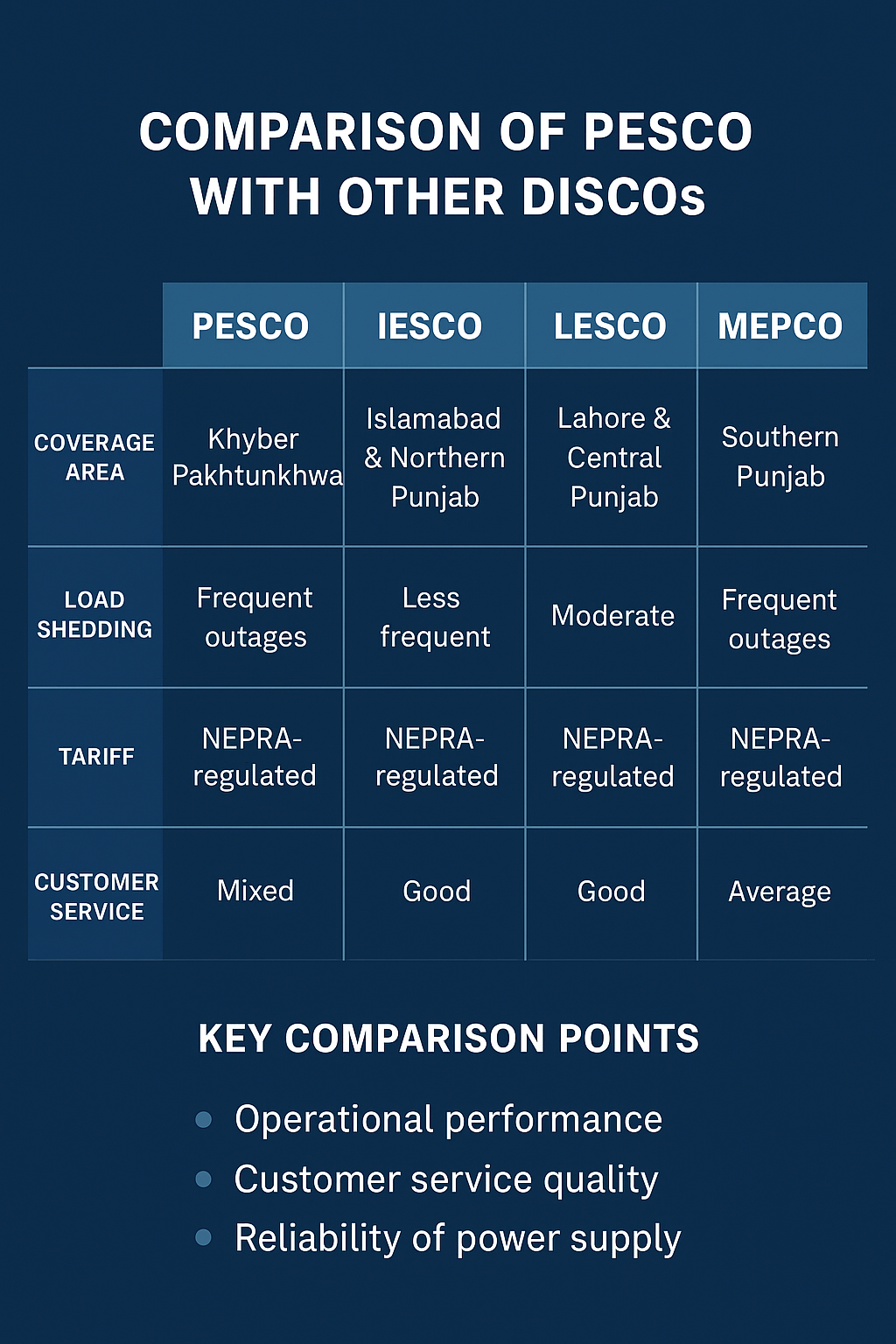
When comparing PESCO with other DISCOs, the first thing to consider is their service regions. Each company operates in a specific geographical area, catering to both urban and rural consumers. This difference in coverage directly affects the quality of service, infrastructure needs, and demand patterns.
Comparison of Service Areas
There’s a quick overview of the regions covered by major DISCOs in Pakistan:
| DISCO | Service Region | Key Cities |
|---|---|---|
| PESCO | Khyber Pakhtunkhwa | Peshawar, Mardan, Swat |
| IESCO | Islamabad & Northern Punjab | Islamabad, Rawalpindi, Jhelum |
| LESCO | Central Punjab | Lahore, Sheikhupura, Kasur |
| MEPCO | Southern Punjab | Multan, Bahawalpur, D.G. Khan |
Urban vs Rural Challenges
Urban areas usually have better infrastructure and faster fault recovery, but they face higher electricity demand, especially in peak summer seasons. On the other hand, rural areas under PESCO and MEPCO often struggle with voltage fluctuations, longer outages, and limited access to modern billing facilities.
Population & Industrial Impact on Power Demand
Regions like Lahore and Islamabad have a strong industrial base, which pushes electricity demand higher, requiring robust grid management. In contrast, PESCO serves a mix of rural and semi-urban areas, where population growth and increasing commercial activity put extra pressure on the distribution system.
Understanding these regional and demographic factors is crucial when comparing the performance and reliability of different DISCOs.
Infrastructure and Network Strength
When it comes to electricity distribution, strong infrastructure and a reliable network are the backbone of any DISCO. PESCO, like other power distribution companies in Pakistan, is responsible for maintaining transmission lines, substations, and distribution feeders across its region.
Transmission and Distribution Network
PESCO manages a vast network spread across Khyber Pakhtunkhwa, covering both urban and rural areas. This includes 132kV and 66kV grid stations, thousands of distribution transformers, and long feeder lines. In comparison, IESCO and LESCO, which operate in urban and semi-urban regions, enjoy better infrastructure, making their systems more stable and efficient. MEPCO, with the largest service area, faces similar challenges to PESCO, particularly in remote regions where network expansion is costly and time-consuming.
Smart Grid Initiatives
To enhance reliability and minimize outages, several DISCOs are introducing smart grid technology. PESCO is gradually moving towards digital solutions, implementing online billing systems, automated metering, and improved monitoring tools. While companies like IESCO and LESCO are ahead in adopting smart metering and automation, PESCO is making steady progress toward modernizing its infrastructure.
Reducing Electricity Theft and Line Losses
One of the biggest challenges for PESCO and other DISCOs is electricity theft and technical losses. These issues lead to significant financial losses and create pressure on the power supply. To tackle this, PESCO has initiated anti-theft campaigns, installed aerial bundled cables (ABC), and strengthened monitoring systems. Other companies like IESCO and LESCO also face similar challenges but have better success rates due to advanced monitoring and urban-focused operations.
A strong, modern infrastructure is the key to improving customer satisfaction and reducing outages, and PESCO’s recent efforts show its commitment to achieving these goals.
Load Shedding and Outage Management
One of the most discussed topics among electricity consumers in Pakistan is load shedding. For PESCO, managing power distribution in Khyber Pakhtunkhwa comes with unique challenges, especially during peak demand seasons like summer.
PESCO Load Shedding Schedule vs Others
PESCO implements scheduled load shedding to balance supply and demand. In high-loss areas or regions with frequent electricity theft, outages can be longer compared to urban areas. On the other hand, IESCO and LESCO, which cover more urbanized regions, often have shorter and more predictable outage schedules. MEPCO, like PESCO, faces similar issues in rural zones where losses and maintenance problems are common.
Managing Peak Demand
During peak hours, such as evenings in summer, PESCO reduces load by rotating outages across feeders to prevent overloading and protect infrastructure. Other DISCOs follow similar strategies, but companies with better infrastructure and smart grid systems, like IESCO, manage these fluctuations more efficiently.
Outage Frequency and Restoration Time
When faults occur due to storms, technical failures, or maintenance, restoration time varies across DISCOs. PESCO, with its large rural network and difficult terrain, sometimes takes longer to restore electricity compared to urban-focused companies like LESCO or IESCO. However, with digital complaint systems and dedicated teams, PESCO is working hard to improve response times and minimize customer inconvenience.
Efficient outage management and fair load shedding schedules are critical for consumer trust, and PESCO’s recent modernization efforts show that it is moving in the right direction.
Electricity Tariff and Billing System
Electricity tariffs and billing processes are some of the most important factors for consumers when comparing PESCO with other DISCOs. While all tariffs are regulated by NEPRA (National Electric Power Regulatory Authority), slight variations can occur due to regional factors like line losses and recovery rates.
Tariff Rates in PESCO vs Other DISCOs
PESCO follows the same basic tariff structure approved by NEPRA, similar to IESCO, LESCO, and MEPCO. However, fuel adjustment charges, taxes, and regional surcharges can make slight differences in the final bill. Like other DISCOs, PESCO bills include fixed charges, unit-based charges, and government taxes, ensuring compliance with national energy policies.
Billing Methods and Payment Options
To make the process easy for customers, PESCO offers multiple billing methods, including online bill viewing and payment options. Consumers can pay their bills through JazzCash, Easypaisa, mobile banking apps, and designated bank branches. This digital shift has reduced the hassle of standing in long queues and improved convenience for users in urban as well as rural areas.
NEPRA’s Role in Tariff Regulation
The National Electric Power Regulatory Authority (NEPRA) plays a crucial role in maintaining fair electricity pricing across Pakistan. It reviews tariff proposals from all DISCOs, including PESCO, and ensures that rates remain uniform and affordable for consumers, while considering operational and fuel costs.
By implementing modern billing systems and easy payment methods, PESCO aims to make the entire process transparent, quick, and user-friendly for its customers.
Customer Service and Complaint Handling
For any electricity distribution company, customer service is just as important as power delivery. Consumers expect quick solutions for billing errors, power outages, and connection issues. PESCO, like other DISCOs, has developed various systems to handle complaints and improve user experience.
Complaint Resolution Systems of PESCO vs Other DISCOs
PESCO offers multiple platforms for customers to register and track complaints, including regional offices, helplines, and online portals. While companies like IESCO and LESCO have slightly more advanced systems due to better infrastructure, PESCO is catching up by expanding its digital services for easy access.
Mobile Apps, Helplines, and SMS Services
To make complaint registration convenient, PESCO provides SMS services and dedicated helplines, allowing consumers to report faults, load shedding issues, and billing problems without visiting offices. Though not as advanced as some other DISCOs, PESCO is working towards introducing mobile apps and automated tracking systems similar to those offered by IESCO and LESCO.
Customer Satisfaction Level Comparison
Customer satisfaction often depends on response time and complaint resolution quality. Urban-based DISCOs like IESCO and LESCO tend to score higher due to better resources and technology. However, PESCO faces additional challenges, such as serving remote areas and handling technical faults across difficult terrains. Despite these hurdles, the company is actively improving its response rate and digital support channels to ensure a better consumer experience.
Providing reliable communication and quick issue resolution is a major priority for PESCO as it works to strengthen its relationship with consumers.
Performance Metrics and Operational Efficiency
The overall success of a power distribution company depends on its operational efficiency, recovery rates, and ability to minimize losses. For PESCO, these performance metrics play a significant role in ensuring financial stability and uninterrupted electricity supply to its consumers.
Recovery Rates and Line Losses Among DISCOs
Like other DISCOs in Pakistan, PESCO faces challenges in revenue recovery and technical line losses. Recovery rates indicate how effectively the company collects billed amounts from consumers. While urban-based companies like IESCO and LESCO often achieve higher recovery percentages, PESCO struggles in some areas due to difficult terrain and scattered rural consumers. High line losses, caused by old infrastructure and illegal connections, remain one of PESCO’s biggest hurdles.
Efficiency in Bill Collection
PESCO is working to improve its bill collection process by introducing digital payment methods, online billing, and easy mobile app solutions. This has helped reduce delays and make the system more transparent. Comparatively, IESCO and LESCO benefit from higher consumer literacy and better access to banking facilities, making their collection process smoother.
Loss Reduction and Theft Control Measures
Electricity theft and technical losses are major challenges across Pakistan’s power sector. PESCO has launched multiple initiatives, such as anti-theft campaigns, installation of aerial bundled cables (ABC), and smart metering projects, to reduce these losses. Other DISCOs, like MEPCO and HESCO, face similar issues, while urban DISCOs have an advantage due to better monitoring and strict enforcement.
Improving operational efficiency and reducing losses will not only strengthen PESCO’s financial position but also ensure a more reliable power supply for consumers across KPK.
Future Plans and Modernization Efforts
To provide reliable electricity and improve customer experience, PESCO is focusing on digital transformation and infrastructure upgrades. These modernization steps aim to reduce outages, improve billing systems, and ensure efficient power distribution across Khyber Pakhtunkhwa.
PESCO’s Digital Initiatives
PESCO has already introduced online bill checking, digital payment options, and SMS-based complaint systems to make services more accessible. The company is also planning smart metering projects, which will help in accurate billing, real-time monitoring, and the reduction of electricity theft. These initiatives are crucial for improving transparency and customer trust.
Smart Metering by Other DISCOs
Other DISCOs, such as IESCO and LESCO, are ahead in smart grid implementation and automated metering infrastructure (AMI). These systems help in detecting faults instantly, reducing line losses, and improving overall network efficiency. PESCO is gradually adopting similar technologies to match the standards of urban-focused companies.
Government and NEPRA’s Role in Modernization
The Government of Pakistan and NEPRA are playing a key role in driving digitalization in the power sector. NEPRA regularly issues guidelines for DISCOs to adopt modern infrastructure and improve service delivery. Through these efforts, PESCO aims to strengthen its network, minimize outages, and offer a customer-centric experience.
Modernization is the only way forward for PESCO and other distribution companies to meet the growing electricity demand and consumer expectations in Pakistan.
Final Comparison Table: PESCO vs Other Major DISCOs
To better understand how PESCO compares to other DISCOs in Pakistan, here’s a summarized comparison based on service region, load shedding, tariff rates, complaint handling, and operational efficiency.
| Feature | PESCO | IESCO | LESCO | MEPCO |
|---|---|---|---|---|
| Service Region | Entire Khyber Pakhtunkhwa province | Islamabad Capital Territory & nearby areas | Lahore and the surrounding districts | Southern Punjab, including Multan |
| Load Shedding | Higher in rural areas, moderate in urban | Relatively low, better supply in urban areas | Moderate, especially during peak hours | Moderate to high in remote areas |
| Tariff Rates | NEPRA-approved uniform tariff structure | Similar NEPRA-approved structure | Follows national tariff rates | Standard NEPRA rates applied |
| Complaint Handling | Helpline, SMS service, complaint offices | Advanced online complaint system | App-based and call center support | Helpline and in-person service |
| Efficiency | Struggles with line losses in remote areas | High recovery and lower line losses | Good recovery, moderate theft issues | Average efficiency with theft control |
What Does This Mean for Consumers?
The table highlights that PESCO faces challenges in rural connectivity and line losses, while IESCO and LESCO excel in complaint handling and urban service efficiency. MEPCO serves a vast rural region like PESCO, which makes management and recovery more difficult.
Overall, modernization and smart grid adoption will help PESCO improve in areas like load shedding management, theft control, and better complaint resolution.
FAQs
Which is better, PESCO or IESCO?
Both have their strengths. IESCO serves major urban areas like Islamabad with better infrastructure, while PESCO covers a large rural region in Khyber Pakhtunkhwa, which makes its operations more challenging but crucial for local development.
Does PESCO have more load shedding than other DISCOs?
Yes, generally, PESCO faces more load shedding compared to IESCO or LESCO due to higher line losses and electricity theft in remote areas. However, PESCO is working on smart grid projects to improve power availability.
What is the electricity tariff difference between PESCO and other DISCOs?
Tariffs are regulated by NEPRA, so the difference is minimal. However, fuel adjustments and regional factors can slightly impact monthly bills for PESCO consumers compared to IESCO or LESCO customers.
Can I pay my PESCO bill online?
Absolutely! PESCO offers multiple online payment methods, including JazzCash, Easypaisa, mobile banking, and online portals, making bill payment easy and convenient for all consumers.
How does PESCO handle complaints compared to other DISCOs?
PESCO has introduced SMS complaint services, call centers, and mobile apps for easy reporting. While urban DISCOs like IESCO might have faster response times, PESCO is expanding its digital complaint handling system to serve consumers better.
What are PESCO’s plans?
PESCO is working on smart metering, automation of billing, and reducing line losses through technology-driven solutions. These initiatives aim to minimize outages, enhance transparency, and improve customer satisfaction.
Conclusion
When comparing PESCO, IESCO, LESCO, and MEPCO, it’s clear that each distribution company has its strengths and challenges. IESCO and LESCO perform well in urban areas, offering better infrastructure and complaint management systems. PESCO and MEPCO, on the other hand, cover large rural regions, which makes load shedding and line losses more challenging to manage.
However, the real takeaway is the importance of continuous improvement in electricity distribution. With initiatives like smart meters, online billing systems, and digital complaint platforms, PESCO is working to enhance its service quality for millions of consumers in Khyber Pakhtunkhwa.
Stay informed about updates from your regional DISCO for a better service experience. Knowing about tariff changes, load-shedding schedules, and complaint solutions can help you manage your electricity needs more efficiently.