
PESCO Fuel Price Adjustment (FPA) – Simple Guide for Consumers
If you live in Peshawar or nearby areas, you probably receive your electricity supply from PESCO (Peshawar Electric Supply Company). Every month when you check your PESCO electricity bill, you might notice an extra charge called Fuel Price Adjustment (FPA). Many people get confused about this term and wonder why their bills keep changing even when their electricity usage stays the same.
Simply put, FPA is an adjustment in your electricity bill that happens because of changes in fuel prices used to generate electricity. When the cost of fuel like oil, gas, or coal increases, power generation becomes expensive, and this extra cost is passed on to consumers as FPA charges.
If you’ve ever thought, “Why is my PESCO bill higher this month?” or “What does fuel price adjustment mean?”—don’t worry. This guide will explain everything about Fuel Price Adjustment (FPA) in easy words so you can understand it better.
Stay with us as we break down what FPA in PESCO bills really means, why it is added, and how it impacts your monthly bill.
What is Fuel Price Adjustment (FPA)?
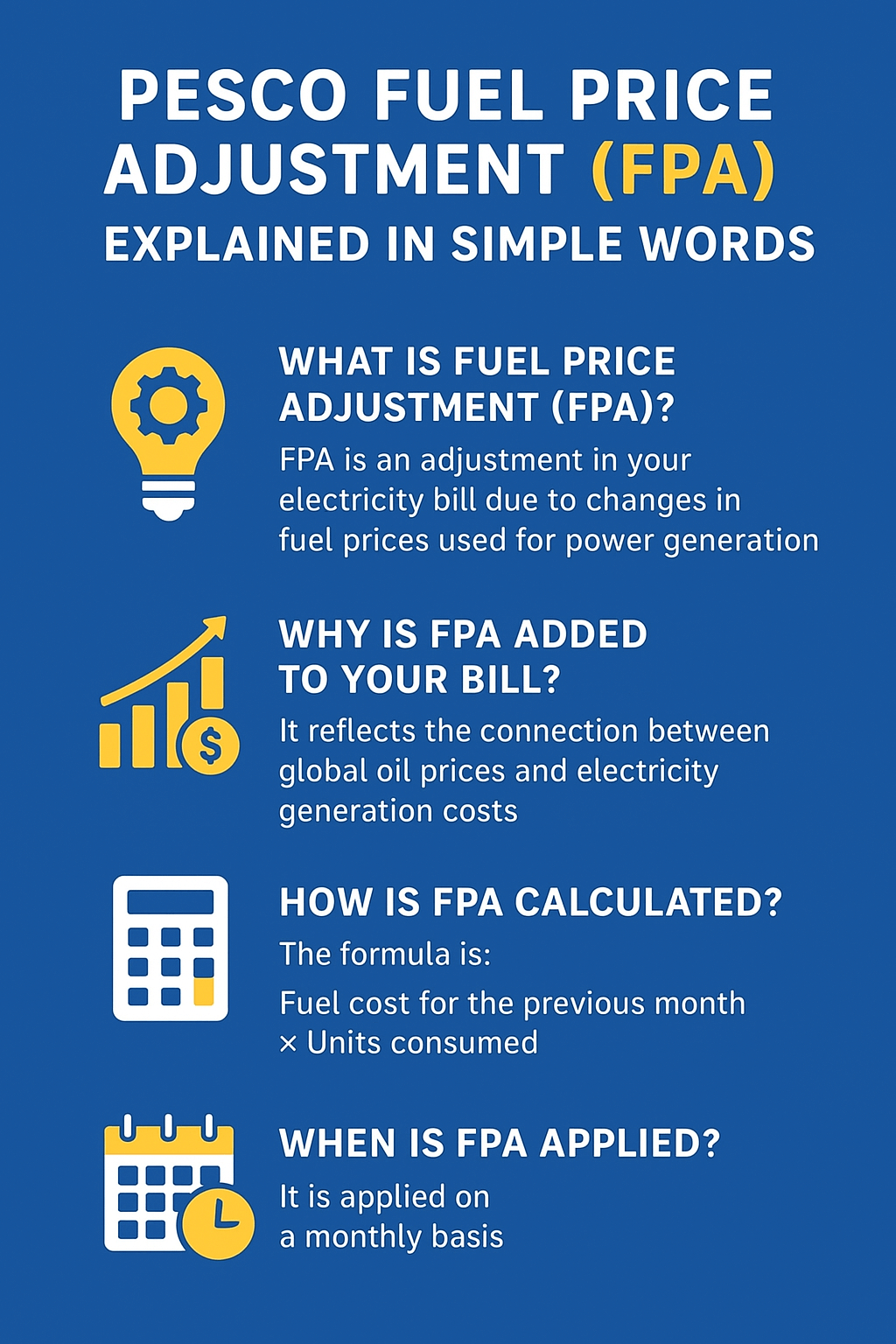
Fuel Price Adjustment (FPA) is an extra amount added to your PESCO electricity bill based on the change in fuel prices used for power generation. In simple words, when the cost of fuel like oil, coal, or gas increases, it becomes more expensive to produce electricity. This additional cost is adjusted in your monthly bill as FPA charges.
The main reason for FPA is that electricity in Pakistan is generated from different fuels, and their prices keep changing in the international market. When the fuel price goes up, the Fuel Cost Adjustment is added to your bill. If the fuel price decreases, the adjustment can be less or sometimes even negative.
The National Electric Power Regulatory Authority (NEPRA) is the authority that approves and regulates these adjustments. NEPRA calculates the fuel cost variation for the previous month and then applies it to the next month’s bills for all electricity distribution companies, including PESCO.
So, FPA is not a fine or penalty—it’s simply an adjustment to cover the difference between the actual fuel cost of generating electricity and the amount already charged in your base tariff.
Why Does PESCO Add FPA to Your Bill?
Global Fuel Prices and Electricity Costs
Electricity generation in Pakistan depends on fuels like furnace oil, coal, and natural gas (LNG). These fuels are often imported, and their prices keep changing in the international market. When global fuel prices rise, the cost of power generation also increases, and this extra cost is reflected in your PESCO bill as Fuel Price Adjustment (FPA).
Why Your Electricity Bill Becomes Higher
When the cost of fuel goes up, it directly impacts the cost per electricity unit. Since PESCO cannot absorb these additional expenses, it adjusts the difference through FPA. This means your bill will be higher in months when global fuel prices are high.
Role of NEPRA and Government Policy
The National Electric Power Regulatory Authority (NEPRA) checks the actual fuel cost every month. If the actual cost is higher than what was charged in the base tariff, NEPRA allows PESCO to recover this difference through FPA. This adjustment is made under government-approved regulations to maintain transparency.
✅ Use PESCO Bill Calculator to check the impact of TV fee and GST
How is FPA Calculated?
Understanding how to calculate fuel price adjustment in PESCO bills is easier than you think. The calculation is based on the previous month’s fuel cost and the number of units you consumed in your billing cycle.
The Basic Formula
While NEPRA uses a detailed formula, in simple words, the FPA amount = (Extra fuel cost per unit × Total units consumed). This means the more units you use, the higher the FPA amount will be on your bill.
Factors Affecting the Calculation
-
Fuel Cost for the Previous Month: If global oil, LNG, or coal prices rise, the fuel cost for generating electricity increases, leading to higher FPA.
-
Units Consumed: The number of electricity units you use in a month directly affects the total FPA charge.
Example of FPA Calculation
Let’s say NEPRA sets an FPA rate of Rs. 2 per unit for the current billing cycle, and you consumed 300 units of electricity.
-
FPA = 300 × Rs. 2 = Rs. 600
This Rs. 600 will be added to your monthly PESCO electricity bill as Fuel Price Adjustment.
So, the FPA amount can change every month depending on global fuel prices and your electricity usage.
When is FPA Applied?
The Fuel Price Adjustment (FPA) in your PESCO bill is not a fixed charge; it is applied on a monthly adjustment cycle. This means the amount is calculated every month based on the previous month’s fuel cost.
Example of FPA Application
For instance, the fuel cost for July will be reviewed by NEPRA, and the adjustment will appear in your August electricity bill. This process ensures that any change in global fuel prices—whether an increase or decrease—is reflected in your bill for the next month.
FPA is Variable, Not Fixed
It is important to understand that FPA can go up or down. If international fuel prices rise, you will see a higher FPA charge in your bill. On the other hand, if fuel prices drop, the adjustment can be lower and sometimes even result in a negative value, giving you a little relief on your electricity bill.
So, if you notice fluctuations in your PESCO bill even when your electricity usage is the same, the reason could be the monthly fuel price adjustment.
Impact of FPA on Your Electricity Bill
If you have ever noticed that your PESCO bill fluctuates every month, even when your electricity usage remains the same, the reason is often the Fuel Price Adjustment (FPA).
Effect of International Fuel Rates on PESCO Bills
The main factor behind these fluctuations is the effect of international fuel rates on PESCO bills. Since Pakistan imports a large amount of fuel for electricity generation, any increase or decrease in global prices has a direct impact on your bill.
When Fuel Prices Rise
If international fuel prices go up, the cost of producing electricity becomes higher. This additional cost is then added to your bill as a higher FPA charge. As a result, your electricity bill increases even if your consumption is the same.
When Fuel Prices Drop
On the other hand, if global fuel prices decrease, the adjustment is lower. Sometimes, the FPA can even be negative, which means you get a slight reduction in your monthly bill. However, this happens less often compared to price increases.
In short, FPA is one of the main reasons why your PESCO electricity bill changes from month to month, regardless of your actual usage.
Difference Between Tariff and FPA
Many consumers confuse tariff with Fuel Price Adjustment (FPA), but they are not the same thing. Understanding the difference will help you read your PESCO electricity bill correctly.
What is a Tariff?
The tariff is the base electricity rate per unit set by NEPRA for your region. This is a fixed cost that does not change every month. It covers the standard charges for generating and supplying electricity under normal conditions.
What is FPA?
The Fuel Price Adjustment (FPA) is an extra adjustment added to your bill when the actual fuel cost for power generation changes compared to what was estimated in the tariff. If fuel prices go up globally, the FPA charge increases, and if fuel prices drop, the FPA decreases.
FPA vs. Surcharge
Some people also think FPA is a surcharge, but that’s not true. A surcharge is an additional tax or fee set by the government, while FPA is a cost adjustment based on real fuel price variations.
So, remember:
-
Tariff = base electricity price
-
FPA = monthly adjustment due to changing fuel costs
Can You Avoid FPA Charges?
The simple answer is no—you cannot avoid Fuel Price Adjustment (FPA) because it is a mandatory cost adjustment approved by NEPRA. This charge is applied to cover the real cost of fuel used in electricity generation, and all consumers under PESCO are required to pay it.
Why FPA Cannot Be Skipped
Since FPA is linked to actual fuel price variations, it is not an optional fee or tax. It ensures that the cost of electricity remains fair and reflects the real expenses of power generation.
How to Lower Electricity Bill Despite FPA
While you cannot remove FPA from your bill, you can still reduce your overall electricity cost by adopting smart energy habits, such as:
-
Use energy-efficient appliances like LED bulbs and inverter ACs.
-
Turn off lights and fans when not in use.
-
Avoid peak hours to reduce high-unit consumption.
-
Unplug devices that are not in use to prevent standby power consumption.
These small changes can make a noticeable difference in your bill, even when FPA charges are high.
FAQs
What is a fuel price adjustment in electricity bills?
Fuel Price Adjustment (FPA) is an additional charge in your PESCO electricity bill that reflects the difference between estimated fuel costs and the actual cost of fuel used for power generation.
Why does PESCO add FPA?
PESCO adds FPA to adjust your bill according to global fuel price changes. When oil, coal, or LNG prices rise, the cost of generating electricity increases, and this extra cost is recovered through FPA.
How is FPA calculated in PESCO bills?
The FPA amount depends on two factors: the additional fuel cost for the previous month and the number of units you consumed. A higher consumption means a higher FPA charge.
Who decides fuel price adjustments in Pakistan?
The National Electric Power Regulatory Authority (NEPRA) decides FPA rates each month after reviewing the actual fuel cost of electricity generation for all distribution companies, including PESCO.
Is FPA the same as fuel surcharge?
No. FPA is not a fuel surcharge. FPA is a cost adjustment due to fuel price variation, while a surcharge is an extra government-imposed tax or fee.
Can FPA be removed from my bill?
No, FPA cannot be removed because it is a mandatory adjustment approved by NEPRA. However, you can lower your overall bill by using energy-efficient appliances and reducing unnecessary electricity consumption.
Conclusion
The Fuel Price Adjustment (FPA) is an essential part of your PESCO electricity bill that reflects the actual cost of fuel used in power generation. It is not an extra tax or hidden charge—it’s simply an adjustment to make electricity pricing fair and transparent.
Since fuel prices in the global market keep changing, FPA ensures that these changes are accurately passed on to consumers. Sometimes it increases your bill, and sometimes it provides a small relief when prices drop.
To avoid surprises in your monthly bill, stay updated with NEPRA announcements about fuel adjustments. Understanding FPA helps you plan your energy usage better and manage your expenses wisely.
Stay informed about your PESCO bill to avoid surprises and make smart choices for energy savings!