How Government Subsidies Impact PESCO Bills – Tariffs & Consumer Relief
When it comes to electricity supply in Khyber Pakhtunkhwa, PESCO (Peshawar Electric Supply Company) plays a major role in delivering power to millions of consumers. From homes and small businesses to large industries, PESCO ensures that energy reaches every corner of the region.
But with rising electricity tariffs and increasing energy costs, paying monthly bills can be a challenge for many households. That’s where government subsidies on electricity bills come in as a big relief. These subsidies are designed to reduce the financial burden on consumers and make electricity more affordable, especially for low and middle-income families.
In this blog, we’ll explore how government subsidies affect PESCO bills, why they are important for consumers, and what the future looks like for energy pricing and tariff reforms. We’ll also discuss how these subsidies impact your overall electricity cost and what changes you can expect in the coming years.
What Are Government Subsidies on Electricity Bills?
Definition of Electricity Subsidy in Pakistan
In simple terms, government subsidies on electricity bills are financial aids provided by the Government of Pakistan to help consumers pay less for electricity. These subsidies work as a price adjustment so that people don’t have to bear the full cost of power generation and distribution. Instead of paying the actual tariff, consumers enjoy reduced electricity rates, which makes monthly bills more affordable.
Why the Government Offers Subsidies on Energy
The main reason behind these subsidies is to support low and middle-income households, boost economic stability, and reduce the financial burden on consumers during times of rising energy costs. Without these subsidies, electricity bills would be significantly higher, especially in areas like Khyber Pakhtunkhwa, where PESCO serves millions of customers.
➡️ Calculator: Foresee how tariff changes affect your future bills
How PESCO Bills Are Structured
Key Components of a PESCO Bill
Every PESCO electricity bill is made up of different components that determine the final amount you pay each month. The main elements include:
-
Fixed Charges – A standard fee that remains the same every month, regardless of your electricity usage.
-
Variable Charges – Charges based on the number of electricity units consumed. The more units you use, the higher your bill will be.
-
Fuel Price Adjustment (FPA) – A variable cost that changes based on fluctuations in fuel prices. This adjustment can either increase or decrease your monthly bill depending on global energy trends.
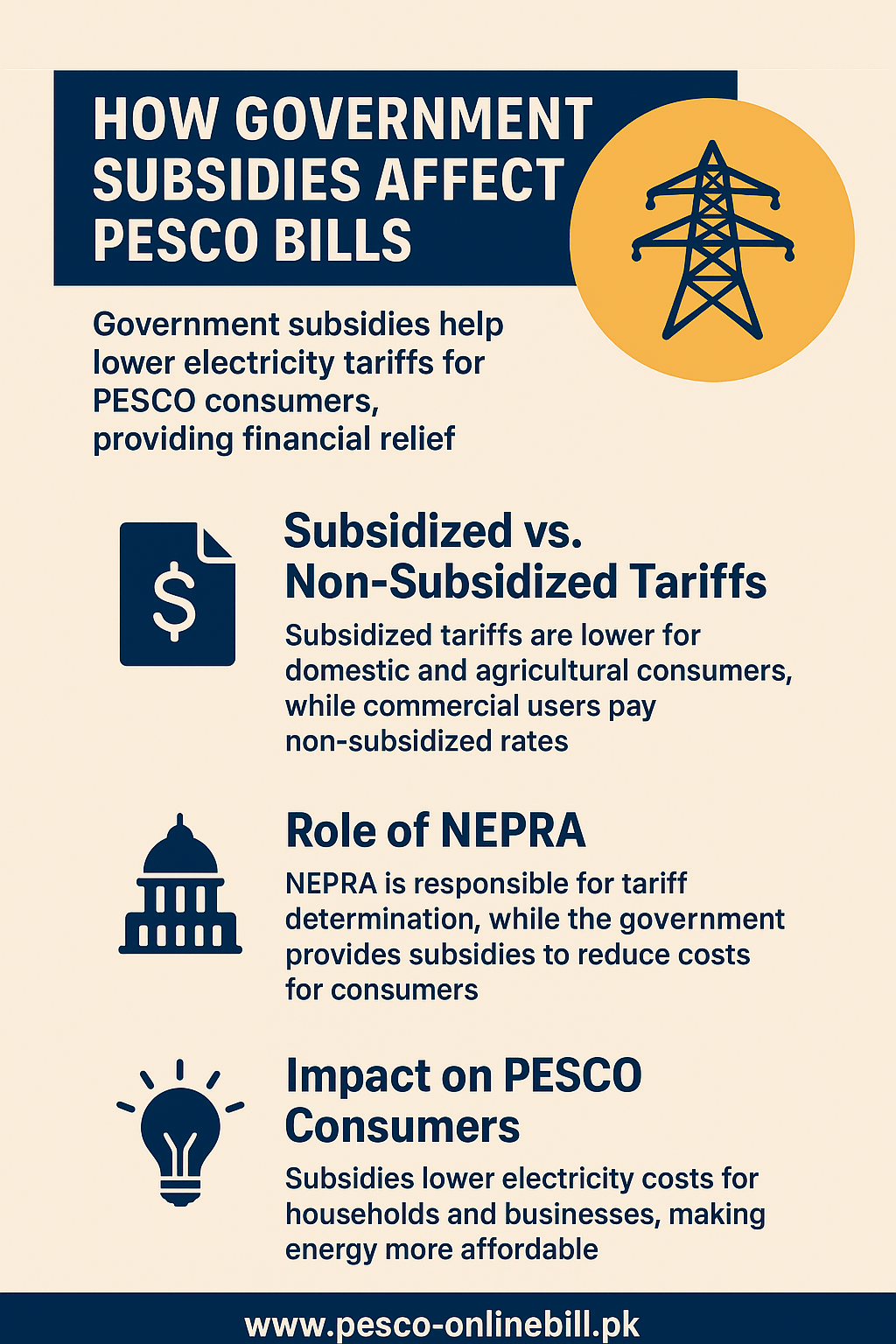
Subsidized vs Non-Subsidized Tariffs
One of the most important aspects of PESCO billing is the difference between subsidized and non-subsidized tariffs.
-
Subsidized Tariffs apply to domestic consumers, especially those using electricity within a specific unit limit. These rates are kept lower to make electricity affordable for households.
-
Non-Subsidized Tariffs usually apply to commercial and industrial consumers, who pay the actual cost of electricity without government relief. This helps maintain cross-subsidization, where higher-paying consumers indirectly support lower-income groups.
Understanding these components and tariff differences is essential for managing your PESCO bills effectively, especially as tariff reforms continue to evolve.
Role of NEPRA in Tariff Determination
NEPRA and Its Function in Power Pricing
When it comes to setting electricity prices in Pakistan, NEPRA (National Electric Power Regulatory Authority) plays the most crucial role. It is the regulatory body responsible for determining the base tariff rates that all power distribution companies, including PESCO, follow. NEPRA ensures that electricity prices are calculated based on production costs, fuel adjustments, and other operational factors, while maintaining a balance between consumer affordability and power sector sustainability.
How NEPRA Tariff Adjustments Work
NEPRA does not set tariffs arbitrarily. The process involves analyzing several components, such as generation costs, transmission losses, fuel price variations, and capacity charges. Once these costs are evaluated, NEPRA issues tariff notifications that apply to all distribution companies. However, the Government of Pakistan often intervenes to provide relief through subsidies, particularly for domestic consumers.
For example, when global fuel prices increase, NEPRA adjusts tariffs upward to cover the additional costs, which is then reflected in Fuel Price Adjustment (FPA) on PESCO bills. Conversely, if fuel costs drop, consumers may benefit from a reduction in FPA charges.
Impact on PESCO Electricity Pricing Policy
The tariffs determined by NEPRA directly shape PESCO’s electricity pricing policy. Every bill you receive is a result of these approved tariffs combined with government subsidies, taxes, and regional adjustments.
-
For domestic consumers, NEPRA-approved tariffs often come with subsidized slabs to make electricity affordable.
-
For commercial and industrial users, the tariffs are mostly non-subsidized, which means they pay the actual cost of electricity without government relief.
This tariff mechanism ensures cross-subsidization, where industrial and commercial sectors help offset the cost burden on low-income households.
Impact of Government Subsidies on PESCO Consumers
How Subsidies Reduce Electricity Tariffs
For millions of PESCO consumers, government subsidies act as a lifeline in managing monthly electricity bills. These subsidies directly lower the electricity tariff, especially for domestic and agricultural consumers, who often face financial challenges due to high energy costs. Instead of paying the full cost of power generation and distribution, consumers benefit from discounted unit rates, which make electricity more affordable.
For example, a household using up to 200 units per month enjoys a lower per-unit rate compared to those in higher usage slabs. This relief helps families manage their expenses without compromising on basic energy needs like lighting, cooling, and household appliances.
Cross-Subsidization: Industrial vs Domestic Consumers
One interesting feature of Pakistan’s electricity pricing structure is cross-subsidization. In simple terms, this means that industrial and commercial consumers pay higher tariffs, while domestic and agricultural users receive subsidized rates. The additional revenue collected from businesses helps offset the cost of providing affordable electricity to low-income households.
While industries bear the actual cost of electricity, these higher charges play an important role in reducing the financial burden on ordinary consumers in Khyber Pakhtunkhwa who rely on PESCO for power.
Real-Life Examples of Consumer Relief
Government subsidies have provided significant relief during periods of rising fuel costs and tariff hikes. For instance:
-
During fuel price increases, the government has absorbed part of the cost to prevent bills from skyrocketing for small households.
-
Agricultural consumers, who rely heavily on electricity for tube wells and irrigation, also benefit from special subsidized rates, ensuring food production remains affordable.
-
Low-income families using electricity within the lifeline tariff (up to 50 units) enjoy the lowest possible rates due to heavy subsidies.
These measures demonstrate how subsidies are not just financial adjustments but essential support systems that protect vulnerable consumers from the full impact of rising energy costs.
Economic Implications of Electricity Subsidies
Budget Allocation for Energy Subsidies
Every year, the Government of Pakistan allocates a significant portion of the federal budget to cover electricity subsidies. These funds are meant to keep power tariffs affordable for domestic users, agricultural consumers, and small businesses. For PESCO consumers, these subsidies help reduce the monthly electricity unit price, making it easier to manage household expenses.
However, this allocation puts a heavy burden on the national budget, as billions of rupees are spent on covering the gap between the actual cost of electricity and what consumers pay. This means less money is available for other development projects like education, health, and infrastructure.
Impact on Inflation and Energy Affordability
While subsidies make electricity affordable in the short term, they also have an impact on the overall economy. By keeping tariffs low, the government prevents inflation from rising sharply, as electricity costs affect almost every sector of the economy. When electricity prices go up, the cost of goods and services also increases, making life more expensive for everyone.
For PESCO consumers, subsidies act as a shield against inflation, ensuring that basic household needs are met without excessive financial pressure. They also support energy affordability programs, which are essential for low-income families.
Connection to IMF Reforms and Subsidy Withdrawal
In recent years, IMF (International Monetary Fund) agreements have influenced Pakistan’s energy pricing policies. The IMF often advises reducing or removing subsidies to improve the financial health of the power sector and reduce the fiscal deficit.
If subsidies are reduced or withdrawn, PESCO bills for domestic consumers could rise significantly, especially for those who currently benefit from lifeline and subsidized tariffs. This shift would mean consumers paying the actual cost of electricity, leading to higher monthly bills and possibly increased financial stress for low and middle-income households.
Future of Subsidies in Pakistan’s Energy Sector
Government’s Shift Toward Sustainable Energy Pricing
The Government of Pakistan is gradually moving toward a sustainable energy pricing policy to ensure financial stability in the power sector. While subsidies have provided relief to millions of consumers, they also create a heavy burden on the national economy. To address this, the government is considering strategies to reduce its dependency on subsidies while promoting renewable energy solutions and efficient electricity consumption.
This means that in the coming years, electricity pricing will likely reflect the actual cost of generation and distribution, with fewer adjustments provided through subsidies.
Possible Reduction or Removal of Subsidies
As part of energy pricing reforms, the government may reduce or even remove certain subsidies to control the rising circular debt and meet international financial commitments. These steps are often recommended under agreements with global institutions like the IMF, which emphasize cost-reflective tariffs.
If implemented, these reforms will significantly affect electricity bills for consumers across Pakistan, including those served by PESCO. The removal of subsidies will especially impact domestic users in lower consumption slabs, who currently benefit the most from government support.
Impact on PESCO Consumers After Subsidy Withdrawal
For PESCO consumers, the end of subsidies would mean higher per-unit electricity rates, particularly for households and agricultural users. Without financial relief, monthly bills could rise substantially, making energy affordability a challenge for many families.
To cope with this change, consumers may need to adopt energy-saving habits, invest in solar energy solutions, and monitor tariff updates regularly. While these changes aim to make the power sector financially sustainable, they also highlight the importance of planning for a future with cost-reflective electricity pricing.
Tips for Consumers to Manage PESCO Bills
Reduce Electricity Cost Burden with Smart Usage
Managing PESCO bills effectively starts with reducing unnecessary electricity consumption. Simple steps like turning off lights and appliances when not in use, using energy-efficient LED bulbs, and minimizing the use of heavy appliances during peak hours can make a noticeable difference. These small habits help lower the electricity units consumed, reducing your overall bill amount.
Switch to Solar Energy for Long-Term Savings
One of the most effective ways to cut down electricity expenses is by adopting solar energy solutions. Installing solar panels can significantly reduce dependence on the national grid, which means lower PESCO bills and protection from tariff hikes. While the initial investment in solar panels may seem high, the long-term savings and stability in energy costs make it a smart financial decision.
Use Energy-Efficient Appliances
Replacing old appliances with energy-efficient models can dramatically reduce electricity consumption. Appliances with energy-saving ratings, such as inverter air conditioners, efficient refrigerators, and washing machines, consume far less power than traditional models. This helps in lowering monthly bills without compromising comfort.
Stay Updated on Tariff Changes and Government Policies
Electricity tariffs and government subsidy policies are subject to change, especially with ongoing energy pricing reforms. Monitoring these updates ensures you can adjust your usage habits accordingly. For instance, knowing about a potential subsidy withdrawal or tariff increase can help you plan your energy usage and budget effectively.
FAQs
What is an electricity subsidy, and why does the government provide it?
An electricity subsidy is a financial relief provided by the Government of Pakistan to make power bills affordable for consumers. The government covers part of the actual cost of power generation and distribution, so households, farmers, and small businesses pay less. The main purpose is to support low and middle-income consumers, maintain energy affordability, and reduce the economic impact of rising electricity tariffs.
How do subsidies affect PESCO electricity bills?
Subsidies directly lower the per-unit electricity cost for consumers under specific slabs or categories. For example, domestic users consuming up to 200 units pay a reduced rate due to government support. Without these subsidies, your PESCO bill would be much higher, as you would be paying the full cost of electricity without any financial relief.
Will subsidy removal increase my electricity bill?
Yes, if the government removes subsidies, PESCO bills will increase significantly. Consumers will have to pay the actual cost of electricity, which includes fuel adjustments, generation costs, and other charges. Low-income households and agricultural users, who currently benefit the most from subsidies, will be the most affected.
What role does NEPRA play in electricity pricing?
NEPRA (National Electric Power Regulatory Authority) is the regulatory body that determines base electricity tariffs for all power distribution companies, including PESCO. NEPRA reviews generation costs, fuel prices, and transmission losses before setting tariffs. These tariffs, combined with government subsidies, shape the final amount you see on your electricity bill.
Which consumer categories get the highest subsidy?
The highest subsidies are provided to domestic consumers in lower usage slabs and agricultural consumers. Households using electricity within the lifeline tariff (up to 50 units) or protected categories benefit from the lowest rates. Agricultural tube wells and rural consumers also receive special relief to support farming and food production.
Conclusion
Government subsidies have always played a crucial role in keeping electricity affordable for millions of PESCO consumers. These subsidies act as a financial cushion, reducing the impact of rising tariffs and fuel price adjustments on household budgets. Without this support, many families and agricultural users would face a significant cost burden.
However, with ongoing energy pricing reforms and economic challenges, the future of subsidies is uncertain. The government aims to move toward a sustainable pricing model, which may involve reducing or gradually removing subsidies. This shift highlights the importance of efficient energy usage, renewable alternatives, and staying informed about policy updates.
To avoid surprises on your PESCO bill, keep an eye on tariff notifications, government subsidy announcements, and adopt energy-saving habits. Being proactive will help you manage costs effectively in a changing energy landscape.