
PESCO Unit Price Guide 2025 – Latest Electricity Tariff & Bill Calculation
When it comes to managing your monthly electricity expenses, one of the most important things every consumer should understand is the PESCO unit rate. The Peshawar Electric Supply Company (PESCO) is responsible for distributing electricity to millions of households, businesses, and industries across Khyber Pakhtunkhwa. Since electricity is measured in units (kWh – kilowatt-hours), knowing how much you are charged per unit helps you keep track of your energy usage and manage your bills more effectively.
For domestic consumers, understanding the electricity tariff is crucial because rates change depending on the number of units consumed each month. Similarly, commercial and industrial users must calculate costs carefully, as their tariffs are higher and directly impact business expenses.
It is also important to know that NEPRA (National Electric Power Regulatory Authority) plays a vital role in deciding these tariffs. NEPRA reviews fuel prices, government policies, and other factors before approving the final NEPRA electricity tariff updates that PESCO applies to consumers.
By understanding the basics of PESCO electricity unit prices, you can not only calculate your bill accurately but also make smart choices to reduce energy costs.
What is 1 Unit of Electricity in PESCO?
When you look at your PESCO electricity bill, the first thing that usually catches your attention is the number of “units” consumed. But many consumers still wonder, what is 1 unit of electricity in PESCO? To put it simply, 1 unit is equal to 1 kilowatt-hour (kWh). This means that if you run an electrical appliance with a power rating of 1,000 watts for exactly one hour, you will be charged for 1 unit.
Think of it as a measure of energy consumption. Just like you buy groceries by the kilogram or milk by the liter, electricity is billed by the unit (kWh). The higher your consumption in units, the more your bill increases.
Understanding kWh (Kilowatt-Hour) in Simple Words
The term kWh electricity meaning might sound technical, but it is actually straightforward.
-
Kilowatt (kW) is a measure of power. For example, a 1000-watt appliance is equal to 1 kilowatt.
-
Hour (h) is simply the duration for which you use that appliance.
So, when a 1 kW appliance runs for 1 hour, it consumes 1 unit of electricity.
Now let’s see how this applies to real-life situations at home and in businesses.
Examples of Appliance Consumption in Units
Electricity usage becomes easier to understand when you relate it to common appliances in your home. Below are some examples that explain how much unit consumption you can expect:
-
A 100-watt fan running for 10 hours → 1 unit
-
A 100-watt bulb switched on for 10 hours → 1 unit
-
A 1-ton AC running for 1 hour → 1.2 to 1.5 units (depending on efficiency)
-
A refrigerator working throughout the day → 2 to 4 units daily
-
An electric iron (1000 watts) used for 1 hour → 1 unit
-
A washing machine cycle of 2 hours → 1.5 to 2 units
From these examples, you can see how daily usage patterns directly affect the total number of units that appear on your PESCO bill at the end of the month.
Electricity Consumption Calculation for Your Bill
If you want to estimate your PESCO bill in advance, you need to calculate the number of units consumed. Here’s a simple method:
-
Find the wattage of your appliance (written on the label or back side).
-
Convert watts to kilowatts by dividing by 1000.
-
Multiply the kilowatt value by the number of hours used.
-
The result will give you the total kWh units consumed.
For example:
-
A 200-watt TV used for 5 hours daily → 200 ÷ 1000 = 0.2 kW → 0.2 × 5 = 1 unit per day
By applying this method to all your household appliances, you can predict your monthly consumption and understand how your electricity tariff slabs affect the final bill.
Current PESCO Electricity Tariff (2025 Updated Rates)
Understanding the latest tariff structure is key to managing your PESCO electricity bill. Below you’ll find the most recent rates and how they apply to different kinds of consumers — domestic, commercial, industrial — and also how protected vs non-protected rates work. This will help you estimate costs and avoid surprises.
Domestic, Commercial & Industrial Unit Rates
PESCO’s tariff per unit (kWh) varies by consumer category. Each category (residential/domestic, commercial, industrial) has its own base rate, plus additional components like fuel charges, fixed charges, and taxes. Because costs for generating, transmitting, and distributing electricity change with time, NEPRA regularly approves tariff updates to ensure the rates reflect real energy/equipment costs.
-
Domestic (Residential) consumers pay lower base rates compared to commercial or industrial users. This is because the load is generally smaller, usage patterns are more predictable, and governments often subsidize residential tariffs or have relief programs.
-
Commercial users (shops, offices, businesses) have higher rates, reflecting larger, more variable load, and sometimes more demand during peak hours.
-
Industrial consumers usually have the highest base rates due to heavy usage, higher voltage supply, and more infrastructure strain (like large motors, heavy machinery, etc.).
These differences are part of what people refer to when talking about “PESCO commercial unit rate” vs “PESCO industrial unit rate” vs “PESCO unit price domestic.”
Tariff Slabs for Domestic Consumers
To ensure fairness, PESCO (as per NEPRA’s guidelines) divides domestic consumer usage into slabs. That means the first portion of your monthly units is charged at one rate, then as your usage increases, higher slabs (higher per-unit rates) apply. This slab structure encourages people to use electricity conservatively.
Here’s roughly how the slabs work (note: exact numbers depend on recent NEPRA notifications and may vary):
| Slab (Units Consumed Per Month) | Rate (Rs/kWh) for Domestic Users* | Comments / Additional Charges |
|---|---|---|
| 0-50 units | lowest rate | often considered lifeline or protected slab |
| 51-100 units | slightly higher | many households fall here |
| 101-200 units | mid-tier rate | higher charges start to apply |
| 201-300 units | even higher | usage in this slab can bump your bill significantly |
| Above 300 units | highest domestic slab rate | highest per-unit rate plus any peak / off-peak variations |
*These are illustrative slab divisions; check the latest NEPRA / PESCO tariff notification for exact Rs/kWh values.
Using slab rates, a household consuming fewer units stays in lower-rate slabs, which means lower cost per unit — an important reason to monitor and control monthly consumption.
Protected vs Non-Protected Consumer Rates
Another distinction to know is between protected and non-protected consumers. This separation is crucial under many energy subsidy / relief programs:
-
Protected consumers are often those with relatively low monthly usage (lower slab categories), sometimes benefiting from subsidized rates or relief measures. The goal is to shield low-income or small users from high electricity bills.
-
Non-protected consumers are those whose monthly consumption goes beyond the protected slab, or who do not qualify for subsidies. They pay the full rate (including all adjustments, taxes, etc.) and usually move into higher slabs with higher rates.
For example, someone who uses only 80-100 units in a month might still qualify for a protected rate, but if that usage crosses, say, 200 units, the non-protected slab rates kick in, which are noticeably higher per unit.
Latest NEPRA Tariff Update Highlights
Here are key points from the recent NEPRA tariff update affecting PESCO:
-
NEPRA has approved a revised uniform base tariff for PESCO / other DISCOs effective FY 2025-26.
-
The average base rate per unit has seen adjustments (increases and/or decreases) to reflect changes in power purchase costs, fuel cost variations, and distribution-related expenses.
-
There are fixed charges / minimum monthly charges that apply even if consumption units are low, especially for commercial or industrial customers. These are in addition to per-unit charges.
Peak Hours vs Off-Peak Hours Rates
Electricity consumption doesn’t cost the same at all times of the day. PESCO follows a time-of-use (TOU) tariff system where the rate per unit is different during peak hours and off-peak hours. Knowing this difference can make a big impact on your monthly bill, especially if you use heavy appliances like air conditioners, heaters, washing machines, or water pumps.
What Are Peak Hours in PESCO?
Peak hours electricity in PESCO refers to the time of day when overall demand for electricity is at its highest. Typically, these are evening hours when households, shops, and businesses are all using electricity simultaneously. Because demand is greater, the cost per unit during peak hours is higher.
This means if you run your washing machine, iron, or AC during peak hours, the bill will reflect a much higher unit rate compared to using them later at night or earlier in the day.
What Are Off-Peak Hours in PESCO?
On the other hand, off-peak PESCO rates apply during the hours of the day and night when electricity demand is lower. During these hours, the cost per unit is reduced, making it the cheapest time to run heavy appliances.
For example, running your washing machine at night or using your water pump during off-peak hours can save you several hundred rupees by the end of the month. Many smart households plan their high-energy tasks specifically during these hours.
How Time-of-Use (TOU) Tariff Impacts Your Bill
The time-of-use tariff PESCO system is designed to encourage energy conservation and better load management. By charging more during peak hours and less during off-peak times, PESCO motivates consumers to shift their usage patterns.
Here’s how it affects your bill:
-
Using electricity during peak hours = higher charges because unit rates are more expensive.
-
Using electricity during off-peak hours = lower charges since the unit rate is cheaper.
-
Businesses and industries can significantly reduce operating costs if they shift heavy machinery use to off-peak hours.
-
Even domestic consumers can save by timing laundry, ironing, and air conditioning outside of peak hours.
PESCO Bill Calculation Using Unit Price
One of the most common concerns for electricity consumers is how to calculate their monthly bill in advance. By understanding the PESCO bill calculation per unit, you can easily estimate how much you will be charged before the bill even arrives. This not only gives you control over your budget but also helps you make smarter decisions about energy consumption.
Step-by-Step Guide to Calculate Your PESCO Bill
To calculate your bill accurately, follow this simple step-by-step method:
-
Check the total number of units consumed – This is clearly mentioned on your PESCO meter or bill.
-
Identify your tariff slab – Based on your monthly units, see which slab you fall into (domestic, commercial, or industrial).
-
Multiply units by the per-unit rate – Use the applicable rate (as per NEPRA-approved tariff) to calculate your base bill.
-
Add additional charges – Include fixed charges, Fuel Price Adjustment (FPA), and any applicable taxes.
-
Apply subsidy or relief (if eligible) – Protected consumers may get reduced rates, which should be factored in.
-
Final bill amount – The sum of the above gives you your estimated electricity bill.
This step-by-step method ensures that you understand exactly how the electricity price per kWh in PESCO translates into your final payable amount.
Example Bill Calculation for Domestic Users
Let’s say a household consumes 250 units in a month. Here’s how the bill would be calculated:
-
First 100 units = charged at the lower slab rate
-
Units 101–200 = charged at the next higher rate
-
Units 201–250 = charged at an even higher rate
Each slab has its own cost per kWh, and the total bill is the sum of all slabs plus additional charges like FPA and taxes.
For example, if the average per-unit cost across these slabs comes to Rs. 20 per kWh, then:
250 units × Rs. 20 = Rs. 5,000 (before taxes and adjustments).
Once you add GST, FPA, and fixed charges, the final bill might be around Rs. 5,500–6,000. This shows how slab rates gradually increase the cost as your usage goes up.
Example Bill Calculation for Commercial Users
Now let’s take a small shop or office consuming 500 units in a month. Commercial tariffs are generally higher than domestic ones.
-
Units 1–500 = charged at commercial rate per kWh (let’s assume Rs. 28 for this example).
-
Total = 500 × 28 = Rs. 14,000 base bill.
After adding fixed charges, taxes, and FPA adjustments, the final payable amount could easily rise above Rs. 15,000.
This demonstrates why commercial users need to be more careful about energy efficiency since even a slight increase in usage can significantly affect the average electricity bill in PESCO.
Additional Charges in PESCO Bill
When you look at your PESCO bill, you might wonder why the amount is often higher than just the per-unit electricity cost. The reason is that several additional charges and adjustments are added on top of the base tariff. These charges are approved by NEPRA and applied across all electricity distribution companies, including PESCO. Understanding these components can help you know exactly where your money is going.
Fuel Price Adjustment (FPA)
One of the most noticeable additions in your bill is the Fuel Price Adjustment (FPA). This is a surcharge applied when the cost of fuel used in electricity generation increases or decreases compared to the original tariff.
-
If international oil or gas prices rise, your FPA charge goes up.
-
If fuel costs drop, the FPA amount might be reduced.
For example, if the FPA is Rs. 3 per unit and you consumed 300 units, an additional Rs. 900 will be added to your bill. This makes FPA a significant factor in your monthly PESCO bill calculation.
Fixed Charges and Taxes
Besides FPA, you will also notice several fixed charges and taxes on your bill. These are standard across all consumers and usually include:
-
Meter rent and service charges – a fixed fee for maintaining your connection.
-
Electricity duty and TV fee – small charges imposed by the government.
-
General Sales Tax (GST) – applied as a percentage of your total bill.
While these charges may seem small individually, together they can add a considerable amount to your total payable bill.
Government Subsidy and Relief Packages
On the brighter side, the government provides electricity subsidies and relief packages for eligible consumers. These usually apply to protected consumers, low-income households, and certain domestic usage categories.
-
For example, users consuming up to 200 units per month may get reduced per-unit rates.
-
Seasonal or emergency relief packages are sometimes announced to support households during inflation or peak fuel cost periods.
These subsidies directly reduce your total bill, helping you manage expenses more effectively.
Factors Affecting PESCO Unit Prices
Have you ever noticed that your electricity bill sometimes gets higher even when your usage stays the same? This happens because the unit price of electricity in PESCO is not fixed. It changes based on several economic, political, and seasonal factors. Understanding these reasons helps you know why PESCO tariff rates fluctuate throughout the year.
Fuel Prices and International Market Changes
One of the biggest reasons behind changes in PESCO unit rates is the cost of fuel used for electricity generation. Pakistan generates power through oil, gas, coal, hydropower, and renewable sources.
-
When global oil or LNG prices rise, electricity production becomes more expensive, and these costs are passed on to consumers in the form of higher per-unit prices.
-
Similarly, if international fuel prices fall, unit costs may decrease slightly, though not always immediately.
This link between fuel price fluctuations and electricity bills explains why consumers often see sudden increases in their PESCO bills.
Government Policies and Subsidies
The government of Pakistan also plays a direct role in setting and adjusting electricity tariffs. Policies regarding subsidies, taxes, and relief packages can either increase or reduce your monthly bill.
-
Subsidies are usually given to protected domestic consumers using lower units per month, keeping their electricity affordable.
-
Withdrawal of subsidies or new tax policies, on the other hand, can push rates upward.
-
NEPRA regularly issues tariff updates in line with government energy policies.
This means your bill is not just about electricity usage—it’s also shaped by government decisions and budgetary allocations.
Seasonal Demand and Load Management
Another major factor is seasonal electricity demand.
-
In summer, when fans, refrigerators, and especially air conditioners are used heavily, demand for electricity peaks. This increased load sometimes leads to higher unit prices or additional surcharges.
-
In winter, demand decreases, especially in areas with low AC usage, which can ease pressure on the system.
Moreover, PESCO uses load management strategies during peak times, and these may come with time-of-use tariffs where peak hour rates are higher than off-peak hours.
Why Do PESCO Unit Prices Keep Changing?
To sum it up, PESCO electricity prices are influenced by:
-
Global fuel price trends
-
Government subsidies and policies
-
Seasonal shifts in demand and supply
That’s why your electricity bill isn’t only about how many units you consumed—it’s also tied to bigger economic and policy factors.
Tips to Reduce Your PESCO Electricity Bill
Electricity costs are a big part of every household and business budget. With rising PESCO unit prices, many consumers are actively looking for the cheapest way to reduce their electricity bills. The good news is that with smart planning, energy-efficient choices, and government-backed programs like net metering, you can cut down your monthly costs significantly. Let’s go through some practical strategies.
Smart Usage During Off-Peak Hours
One of the easiest ways to save money is to shift most of your heavy electricity usage to off-peak hours. PESCO applies time-of-use (TOU) tariffs, which means electricity during peak hours (usually evenings) costs more than during off-peak times.
-
Run washing machines, irons, and other heavy appliances during off-peak hours.
-
Avoid unnecessary use of air conditioners and heaters during peak load times.
-
Schedule tasks like water pumping or charging UPS batteries in cheaper hours.
By managing your daily routine around TOU tariff timings, you can lower your bill without reducing comfort.
Energy-Efficient Appliances
Switching to energy-efficient appliances is one of the smartest long-term investments for reducing electricity costs.
-
Replace old bulbs with LED lights that consume up to 80% less electricity.
-
Use inverter-based ACs and refrigerators that adjust power consumption according to load.
-
Look for appliances with energy star ratings, as they are designed for electricity conservation.
Even though these appliances may cost more initially, they quickly pay back by lowering your monthly PESCO electricity bill.
Solar System and PESCO Net Metering
If you want a permanent solution to high bills, installing a solar system with PESCO net metering is the way forward.
-
A solar setup allows you to generate your own electricity from sunlight.
-
Through net metering, excess electricity is supplied back to the grid, and the amount is adjusted in your bill.
-
Over time, this reduces dependence on expensive grid electricity and helps you save significantly.
Many households and businesses in KPK are already adopting solar solutions, not only to cut costs but also to ensure uninterrupted power supply during load shedding.
Monitoring Monthly Consumption Slabs
Your bill is calculated based on PESCO tariff slabs. Small differences in unit consumption can shift you into a higher slab with a much higher per-unit rate.
-
Keep track of your monthly electricity usage.
-
Try to stay within the lower consumption slabs by turning off unnecessary lights and appliances.
-
Encourage your family to practice energy-saving habits, like unplugging chargers when not in use.
A little awareness about slab limits can make a huge difference in lowering your average electricity bill.
FAQs
What is the current PESCO unit rate?
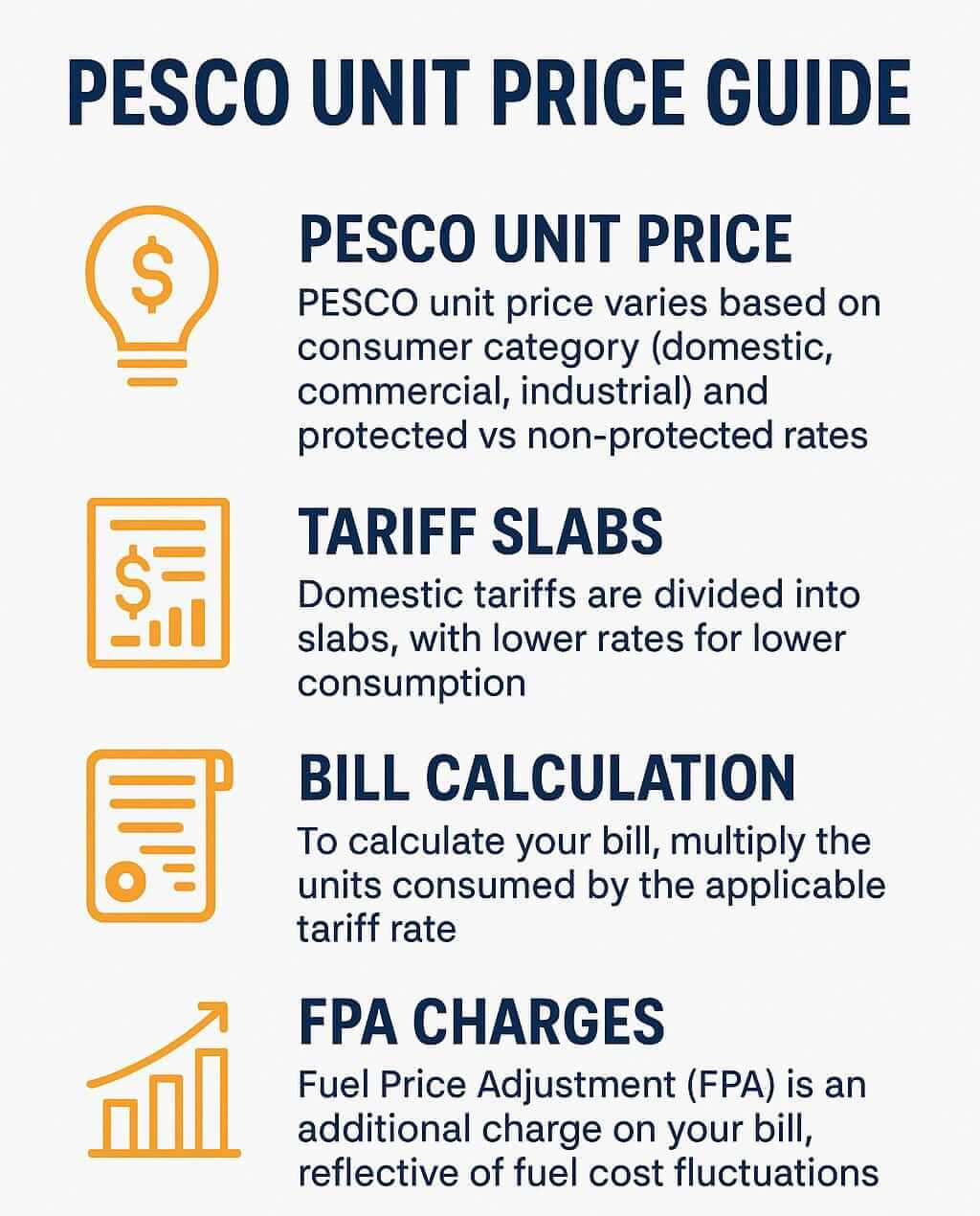
The PESCO unit rate in 2025 depends on your consumer category (domestic, commercial, or industrial) and whether you are a protected or non-protected user. For domestic consumers, rates are divided into slabs—the more units you consume, the higher the per-unit price. Commercial and industrial users generally have higher tariffs compared to households.
How to calculate PESCO bill per unit?
To calculate your PESCO bill per unit, simply multiply the number of units consumed by the applicable tariff rate. Then add additional charges like Fuel Price Adjustment (FPA), taxes, and fixed charges. For example, if you used 300 units and the rate is Rs. 25 per unit, your base bill will be Rs. 7,500. After adding FPA and taxes, the final amount may be higher.
What is the difference between protected and non-protected consumers?
-
Protected consumers are domestic users consuming up to 200 units per month, and they enjoy lower electricity rates as per government subsidies.
-
Non-protected consumers use more than 200 units or fall under commercial/industrial categories, so they are charged at higher tariffs without subsidy benefits.
This classification directly affects how much you pay for each unit of electricity.
Does PESCO offer subsidized electricity rates?
Yes, PESCO provides subsidized rates for protected consumers as part of government energy relief programs. These subsidies are designed to make electricity more affordable for low-income households and small domestic users. However, commercial and industrial users generally do not get subsidies and pay standard tariff rates.
How does FPA affect PESCO bills?
The Fuel Price Adjustment (FPA) is one of the most important components in your bill. It reflects the difference between the estimated fuel cost in the tariff and the actual fuel cost used in power generation. If international fuel prices increase, the FPA adds extra charges to your bill. If fuel costs drop, the FPA may reduce slightly, but usually, it increases the total payable amount for most consumers.
Conclusion
Understanding the PESCO unit price structure is the key to managing your electricity expenses smartly. Since the latest PESCO electricity tariff is based on factors like consumption slabs, fuel prices, government policies, and seasonal demand, your monthly bill can vary even if your usage stays the same. That’s why it’s important to stay informed about tariff updates and be aware of additional charges like FPA, taxes, and fixed costs.
By keeping track of tariff slabs, monitoring your monthly usage, and applying simple energy-saving tips, you can prevent unnecessary high bills. For those looking at long-term solutions, PESCO net metering and solar systems are also effective ways to control electricity costs.